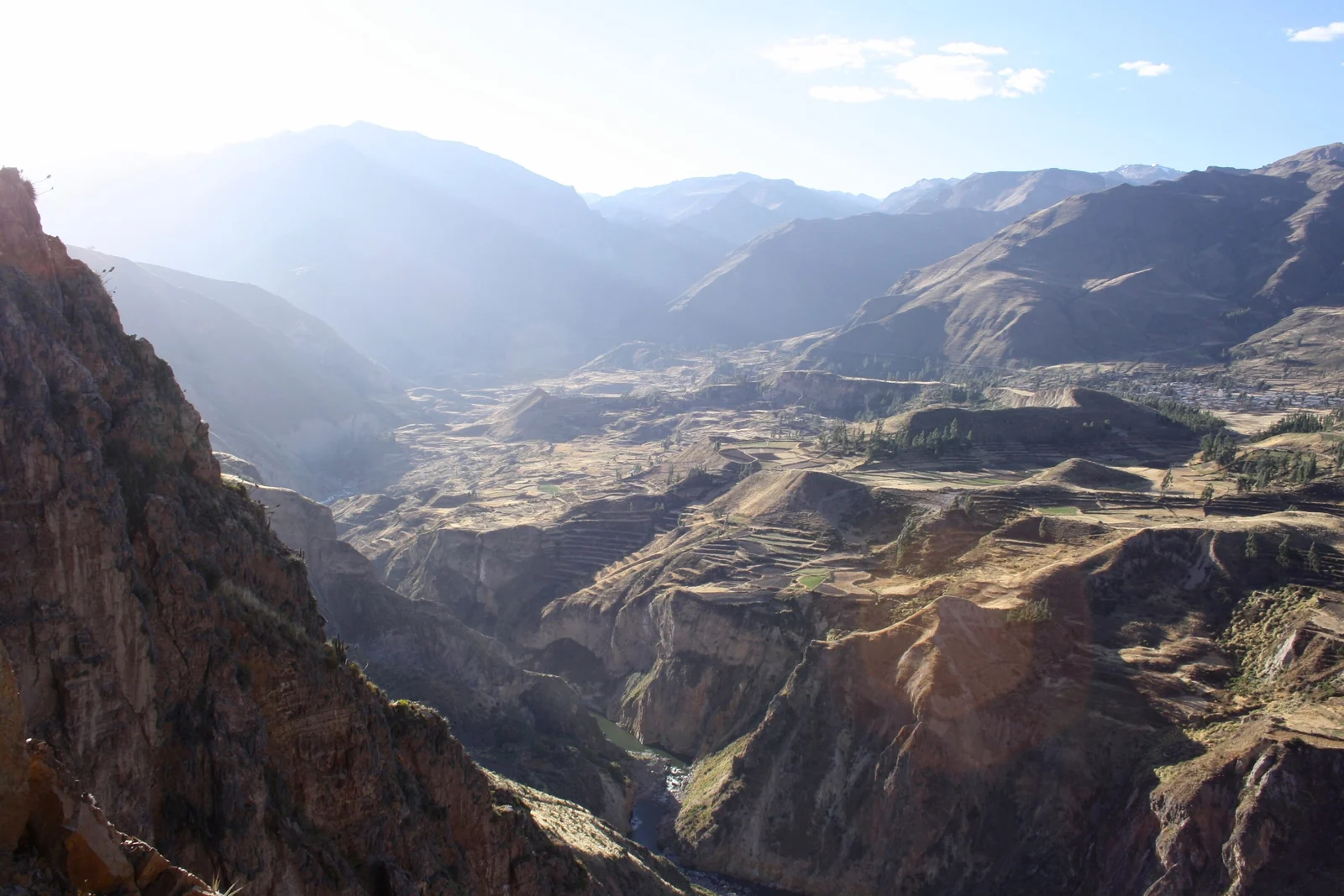
Colca Canyon is a deep river gorge in the Andes of southern Peru, roughly 160 km northwest of Arequipa. People go for three things: the sight of Andean condors riding the air off the canyon walls at Cruz del Cóndor, a valley of pre-Inca farming terraces and small Andean villages, and a steep trek to a green oasis on the canyon floor. It is also the easiest big-canyon trip in the country to fit into a Peru itinerary, because Arequipa is a short flight from Lima or Cusco.
The practical version: allow two days and one night at minimum, three if you want the trek, and give yourself time to adjust to the altitude first. This Colca Canyon guide covers how deep the canyon really is, the best time for condors, the road from Arequipa, the 2-day hike to Sangalle, tours versus public buses and what to pack. If you are building a longer trip, our Peru travel guides cover the rest of the country.
How Deep Is Colca Canyon?
Colca is often called one of the deepest canyons on Earth, and that is fair as long as you do not insist on a single number. Published figures run from about 3,270 meters to about 3,400 meters, depending on the source and on where the top and bottom are measured. A 1981 Polish rafting expedition first ran the river below Cabanaconde and suggested it might be the world's deepest canyon, a claim that was widely repeated afterward.
Since then, neighboring Cotahuasi Canyon has taken the title in most rankings. NASA's Earth Observatory describes Cotahuasi as reaching 3,354 meters below the top of the plateau and as likely the deepest canyon on any continent. Estimates for both gorges shift with the method, because a canyon's depth depends on which rim and which point on the river you choose. Treat "deepest in the world" as a marketing line, and "among the deepest" as the honest one.
At the viewpoint you will use, the numbers are more modest and easier to feel. At Cruz del Cóndor the canyon floor lies roughly 1,200 meters below the rim, which is still enough to make the river look like a thread. You can read the NASA comparison on its Deepest Canyons of the Andes page.
Arequipa to Colca Canyon: The Route
Nearly everyone starts in Arequipa, the white-stone city at the foot of the Misti volcano, at roughly 2,300 meters. The road to Chivay, the main town of the valley, takes about three and a half to four hours by tourist bus. It climbs through dry highland and the Salinas y Aguada Blanca reserve, where you may see vicuñas grazing, then crests the Patapampa pass.
Patapampa Pass
Patapampa is generally reported at about 4,900 meters above sea level, with some sources giving a figure a little lower. Buses stop at a viewpoint where you look across a line of volcanoes. This is where altitude sickness often hits first, so keep the stop short, walk slowly and skip the sprint to the photo spot. The road then drops more than a thousand meters in well under an hour to Chivay, at about 3,600 meters.
Chivay and the Colca Valley
Chivay is the practical base: a market town with lodgings, small restaurants and the transport hub for the valley. From here the road follows the river for roughly 56 km down to Cabanaconde, passing small villages with colonial churches. Before the Inca, the valley was home to two peoples, the Quechua-speaking Cabanas and the Aymara-speaking Collaguas, and their terraces are still farmed today.
Cruz del Cóndor: Best Time for Condors
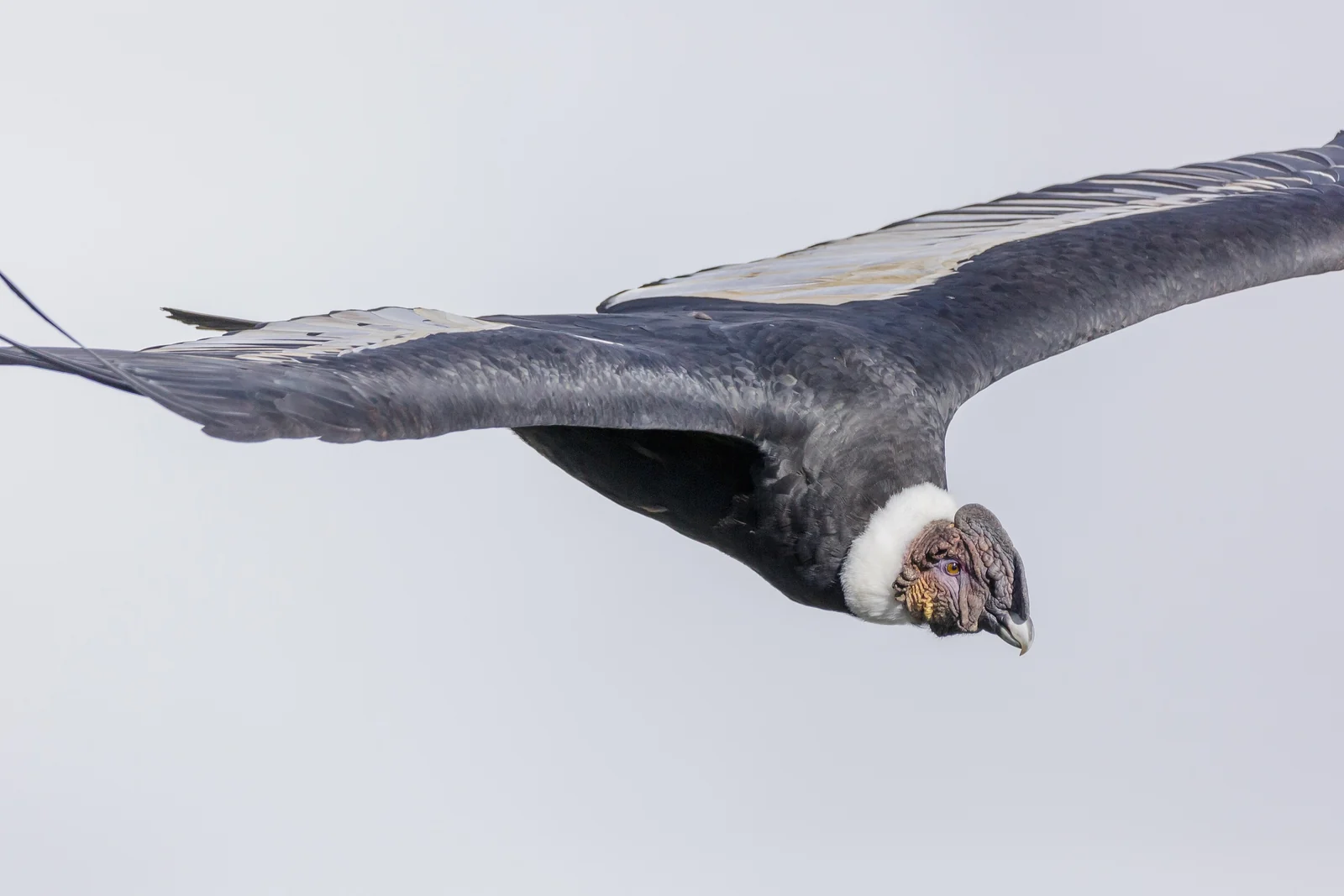
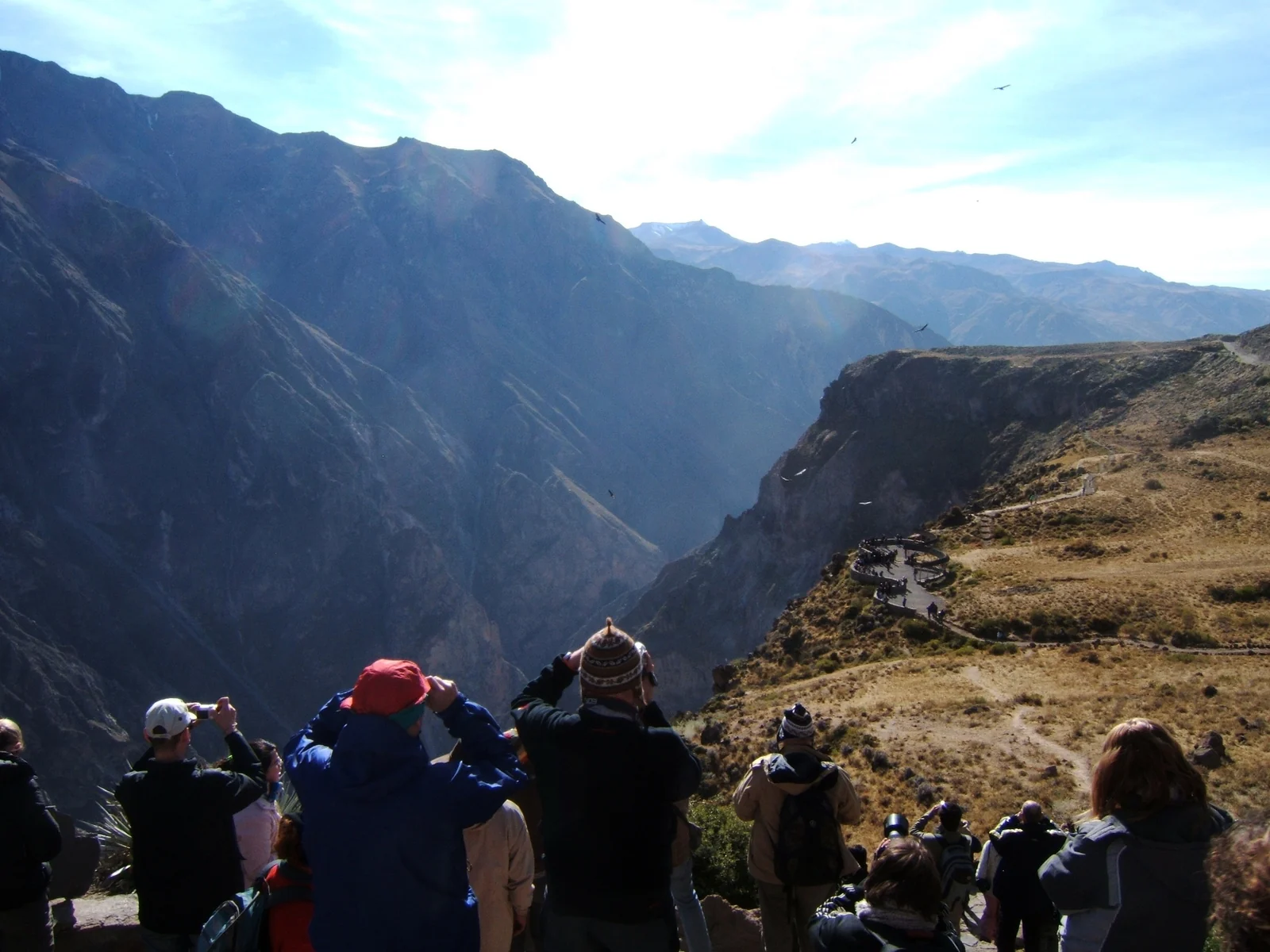
The Cruz del Cóndor viewpoint sits on a rocky spur above one of the canyon's deepest stretches, between Chivay and Cabanaconde. Andean condors, with wingspans of more than two meters, glide along the walls below and beside you, sometimes close enough to see the white ruff on the neck. Seeing them is never guaranteed, but at this spot it is common.
The best time is early morning, roughly 7:30 to 10 a.m. Condors barely flap their wings. They wait for the sun to warm the canyon walls and create rising air, then spiral up on it. That is why the show peaks once the light has reached the rim, and why a hazy, cold start can delay the first bird by an hour. Arrive by about 8 a.m. and plan to stay at least an hour. Afternoon flights happen but are usually fewer.
How to See More Condors and Fewer Crowds
- Stay in the valley. Sleeping in Chivay or Cabanaconde lets you reach the viewpoint for the first thermals, rather than arriving with the day-trip buses.
- Look along the rim. Condors often pass at eye level along the walls beside the main platform, so walk a little way along the path rather than staying at the crowded rail.
- Bring binoculars. A pair turns distant dots into birds you can identify.
- Stay quiet and still. Do not throw food, wave drones or crowd the edge, and stay behind the barriers.
Hot Springs and Villages Around Chivay
The best reward after a cold morning is a soak. The La Calera hot springs, a short ride from Chivay, are the most visited of several thermal pools in the valley. They are popular with tour groups in the afternoon, so go early or late if you want space. Bring a towel and swimsuit, and check opening hours locally before you plan around them.
Between Chivay and Cabanaconde, small villages such as Yanque and Maca have old stone churches and market stalls, and tours often stop in them on the way to the canyon.
The 2-Day Colca Canyon Trek to Sangalle
The classic short hike drops from Cabanaconde to the Sangalle oasis, usually called simply "the Oasis," on the canyon floor, and climbs back out the next morning. Cabanaconde sits at about 3,300 meters. Sources put the oasis between roughly 1,900 and 2,200 meters, so expect a descent of about 1,100 to 1,400 meters, and the same climb in reverse.
Day 1: Down to the Oasis
Leave Cabanaconde in the morning and follow the switchbacks down. The path is dusty and exposed, and the descent takes roughly three to four hours. You cross the river on a footbridge, then walk the last stretch to Sangalle, a green pocket of palms, small plantations and simple lodgings, some with swimming pools. It is warmer here than anywhere else on the trip, so the pools feel earned.
Day 2: The Climb Out
The way back is the hard part. Plan on about two to three hours at a steady pace, and start before the sun hits the slope. Go slowly, take small steps and drink often. Locals offer mules for the climb at a negotiated price, and many hikers take one without shame. After the climb, Cabanaconde is a good place for a long lunch.
Do you have more time? Longer versions link other villages on the canyon floor and add a night. For a bigger Peruvian challenge, see our Choquequirao trek guide, which uses a similar kind of canyon descent on a much larger scale.
Tours vs Independent Travel
| Option | How it works | Pros | Trade-offs |
|---|---|---|---|
| 1-day tour from Arequipa | Very early departure, Cruz del Cóndor, a few villages, return at night | Simple, cheapest in effort | Long hours on the road, high altitude on day one, rushed at the viewpoint |
| 2-day tour with the trek | Overnight in the valley or at the Oasis, guided descent and climb | Logistics handled, condors on day two | Fixed pace, groups |
| Public bus and local transport | Bus from Arequipa to Chivay, local transport on to Cabanaconde | Flexible, more time in the valley | Need to organize your own lodging and the trek |
| Private driver | A car with a driver, with your own stops | Your timetable, early viewpoint arrival | More expensive than buses |
A one-day tour is possible, but it is a poor fit for the place. You spend most of the day on the road, and the whole trip is above 3,000 meters. If you can, sleep in the valley, ideally in Cabanaconde, so you can be at Cruz del Cóndor before the buses arrive.
Independent travel is easy enough. Buses run from Arequipa to Chivay, and from there local buses and shared transport continue through the valley to Cabanaconde. Schedules change, so ask at your lodging or the terminal the day before. The trek itself is simple enough to do without a guide if you are fit and sensible, though a guide is a fair choice on a first visit, especially in poor weather.
The Tourist Ticket
Visitors who enter the valley are asked to buy a boleto turístico, a tourist ticket sold in Chivay and other points along the way. Tour prices often include it, independent travelers pay for it separately, and the price and rules differ for foreign and Peruvian visitors. Check the current price and what it covers locally, and keep the ticket with you.
Altitude and Acclimatization
The jump from Arequipa to the Patapampa pass is large and quick, and many people feel it. Headache, nausea and shortness of breath are common at these heights, and they are the usual reason people feel flat on the first evening in Chivay.
- Spend a day or two in Arequipa first. At about 2,300 meters it is a gentle start, especially if you have just arrived from the coast.
- Go slowly at the pass. Keep the stop short and do not exert yourself.
- Drink water, eat lightly and skip alcohol on your first night in Chivay.
- Know when to descend. Severe headache, confusion or breathlessness at rest mean you should get lower and seek medical help.
- Ask your doctor about altitude medication before you travel, rather than deciding on the road.
If you are coming from Cusco or Machu Picchu, you are probably already acclimatized. Our Machu Picchu travel guide explains how to fit the two trips together, and the history of that site is in The Story Behind Machu Picchu.
Best Season and What to Pack
When to Go
The dry season, roughly May to October, is the best time. Skies are clear, trails are firm and the views are sharp. The trade-off is cold: nights in Chivay and Cabanaconde are chilly, and mornings at the viewpoint feel colder than the sun suggests. The wetter months bring cloud and afternoon rain, and trails become slippery, but condors still fly, and morning visits are still the best option.
Packing List
- Layers: a warm jacket, hat and gloves for the viewpoint, and light, breathable clothes for the canyon floor.
- Sun protection: high-altitude sun is intense, so bring a hat, sunglasses and strong sunscreen.
- Sturdy shoes with a good grip for loose, dusty switchbacks, plus trekking poles if you use them.
- Water and snacks: at least two liters for the descent, with a way to refill or treat water.
- Swimsuit and towel for the Oasis pools and the hot springs.
- Cash in small notes for village shops, mules and tickets, since cards are rarely accepted outside Arequipa.
- Binoculars and a headlamp for condors and early starts.
Before booking, check the official Peru tourism site for current travel advice, and your lodging for road conditions.
Colca Canyon FAQ
How deep is Colca Canyon?
Published figures range from about 3,270 to 3,400 meters, depending on how depth is measured. Cotahuasi Canyon nearby is usually ranked deeper. At Cruz del Cóndor the floor is roughly 1,200 meters below the viewpoint.
What is the best time to see condors at Cruz del Cóndor?
Early morning, roughly 7:30 to 10 a.m., once the sun warms the walls and creates the rising air condors use. Arrive around 8 a.m. and allow at least an hour. Condors are present year-round, but the dry season has clearer skies.
How long does it take to get from Arequipa to Colca Canyon?
About three and a half to four hours by bus to Chivay, crossing the Patapampa pass at roughly 4,900 meters. Cruz del Cóndor is farther along the valley, so a stay in Chivay or Cabanaconde saves a very early start.
Can you do the Colca Canyon trek in 2 days?
Yes. The usual route descends from Cabanaconde to the Sangalle oasis on day one, in roughly three to four hours, and climbs out on day two in about two to three. It is steep and hot, so start early and carry plenty of water.
Do you need a guide for the Colca Canyon trek?
The main Cabanaconde to Sangalle route is well used, and fit, experienced hikers often go without a guide. A guide helps on a first visit, in poor weather or if you want logistics handled. Ask locally about current conditions.
What is the best time of year to visit Colca Canyon?
The dry season, roughly May to October, brings clear skies and firm trails, with cold nights. The wetter months have cloud and afternoon rain, and the trails are slippery, but condor flights still happen in the mornings.
Is altitude a problem at Colca Canyon?
It can be. Chivay is at about 3,600 meters and the road crosses a pass near 4,900. Spend a day or two in Arequipa first, go slowly, drink water and avoid alcohol on arrival. Descend and get help if symptoms are severe.