Villa Epecuén is a former salt-lake resort in Buenos Aires Province, Argentina, that spent about 25 years under water after a flood in 1985. The lake has since pulled back, and the ruins now stand in the open: bare tree trunks, snapped walls and streets crusted with white salt. You visit from the town of Carhué, roughly 7 to 8 km away, and the trip works as a long day out or an overnight stop on the way across the Pampas.
It is one of the strangest places you can reach from Buenos Aires without leaving the province. If you are building a longer trip, start with our Buenos Aires travel guide, then use this page to decide whether a drowned town deserves a day of your time. For anyone who likes ruins, it does.
From Salt-Lake Spa to Drowned Town: The Story of Villa Epecuén
Epecuén grew up as a lakeside resort in the early 1920s, built around the idea that a very salty lake could heal. People came to float in the water and soak in the mud, and trains from Buenos Aires made the trip easy. Over the following decades the village filled with guesthouses, shops and bathing facilities. Estimates put the number of businesses at up to about 280, and the village could host around 5,000 visitors at its height.
Summers were the season. Reports describe roughly 25,000 tourists a year arriving between November and March from the 1950s into the 1970s, a big crowd for a place with about 1,500 permanent residents at its peak. Picture a small Pampas version of a seaside promenade, with ice cream, busy sidewalks and families on holiday, hundreds of kilometers from any ocean.
The lake had always been moody. Lago Epecuén has no outlet to the sea, so its level swings with rainfall and runoff, and the surrounding plain is almost perfectly flat. The village depended on a dike to keep the water out. That detail matters for what came next.
The 1985 Flood and the Return of the Ruins
On 6 November 1985 the defenses failed. Accounts describe a rare weather-driven oscillation of the lake, a seiche, that broke a nearby dam and then the protective dike. Water poured over the village and kept rising until it reached a peak of about 10 m. The town became uninhabitable and was never rebuilt.
Be wary of any guide who recites exact casualty or damage numbers without a source. What is solid is the outcome: a town of hotels, houses and shops was abandoned, and its streets disappeared under salty water for years.
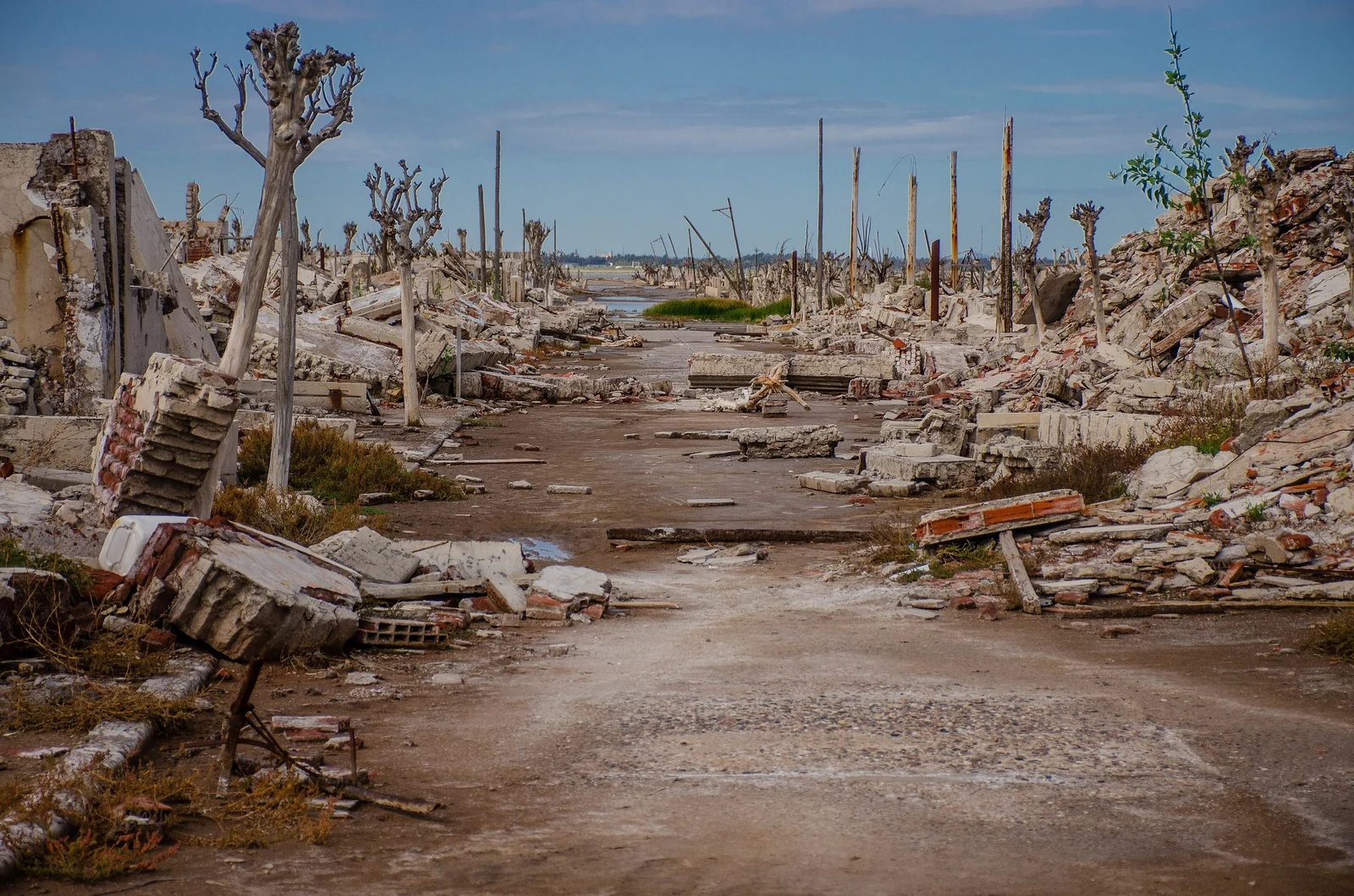
The salt did what salt does. It soaked into brick and concrete, killed the trees and slowed the usual rot, which is why the ruins look bleached and oddly preserved rather than overgrown.
When the Water Retreated
The lake began to fall back around 2009, after the village had been submerged for about 25 years. As the water dropped, streets, walls and tree trunks surfaced again, coated in white and grey salt. Few places show a disaster in reverse as clearly as this one.
One name comes up in nearly every account: Pablo Novak, born in 1930, the last resident. According to reference sources, he returned to his house in the ruins after the water left and lived there until his death in January 2024, after which the village was officially considered deserted. A 2013 documentary, Pablo's Villa, followed him. I have not verified whether any guided visit still draws on his story, so do not count on that.
Today the landscape is a mix of managed and untouched. There are routes, information panels with old photographs and a municipal ticket system, but you are still walking through a collapsed town, not a museum.
Where to Base Yourself: Carhué
Carhué is the real town here, founded in 1877 and the seat of the Adolfo Alsina district. It sits about 520 km from Buenos Aires, and the thermal waters of Lago Epecuén, a few kilometers away, are the reason it has a tourism industry at all. Its population was around 16,000 at the 2001 count.
It is the logical base. You will find places to sleep and eat, the spa facilities, and the municipal offices that handle entry to the ruins. I will not name a specific hotel I cannot vouch for. Book in Carhué, not near the ruins, and reserve early if you plan to come in the summer holiday months.
How to Get to Villa Epecuén From Buenos Aires and Bahía Blanca
There is no metro stop at the end of this trip. Distances are long and the road runs straight across farmland, so plan for most of a day each way if you start in the capital.
| Starting point | Rough approach | What to expect |
|---|---|---|
| Buenos Aires | Long-distance bus to Carhué, or drive about 520 km | A full travel day; many visitors split it with a night in Carhué |
| Bahía Blanca | Drive or take a bus toward Carhué | Shorter than from the capital, a few hours on the road |
| Carhué to the ruins | Taxi, own car, bike or guided visit | About 7 to 8 km, a short drive and doable by bicycle |
Bus companies and schedules change, so confirm times at the terminal or on the operator's own site rather than trusting an old timetable. If you drive, the roads across the Pampas are flat and straightforward, but fuel stops can be far apart, so fill up before leaving a bigger town.
From Carhué, the ruins are a quick drive. One route description mentions a walk of roughly an hour and a half, and bicycles can be rented in the center, which suits the flat ground. I would drive or cycle in and walk once you are inside, because the site is big enough to tire you on foot.
What to See: Dead Trees, Concrete Shells and the Old Slaughterhouse
You pay a modest entry fee at the municipality of Carhué, which owns the site. I could not find a current official price or hours, so ask at the Carhué tourism office before you go. Then the walk begins.
The Salamone slaughterhouse
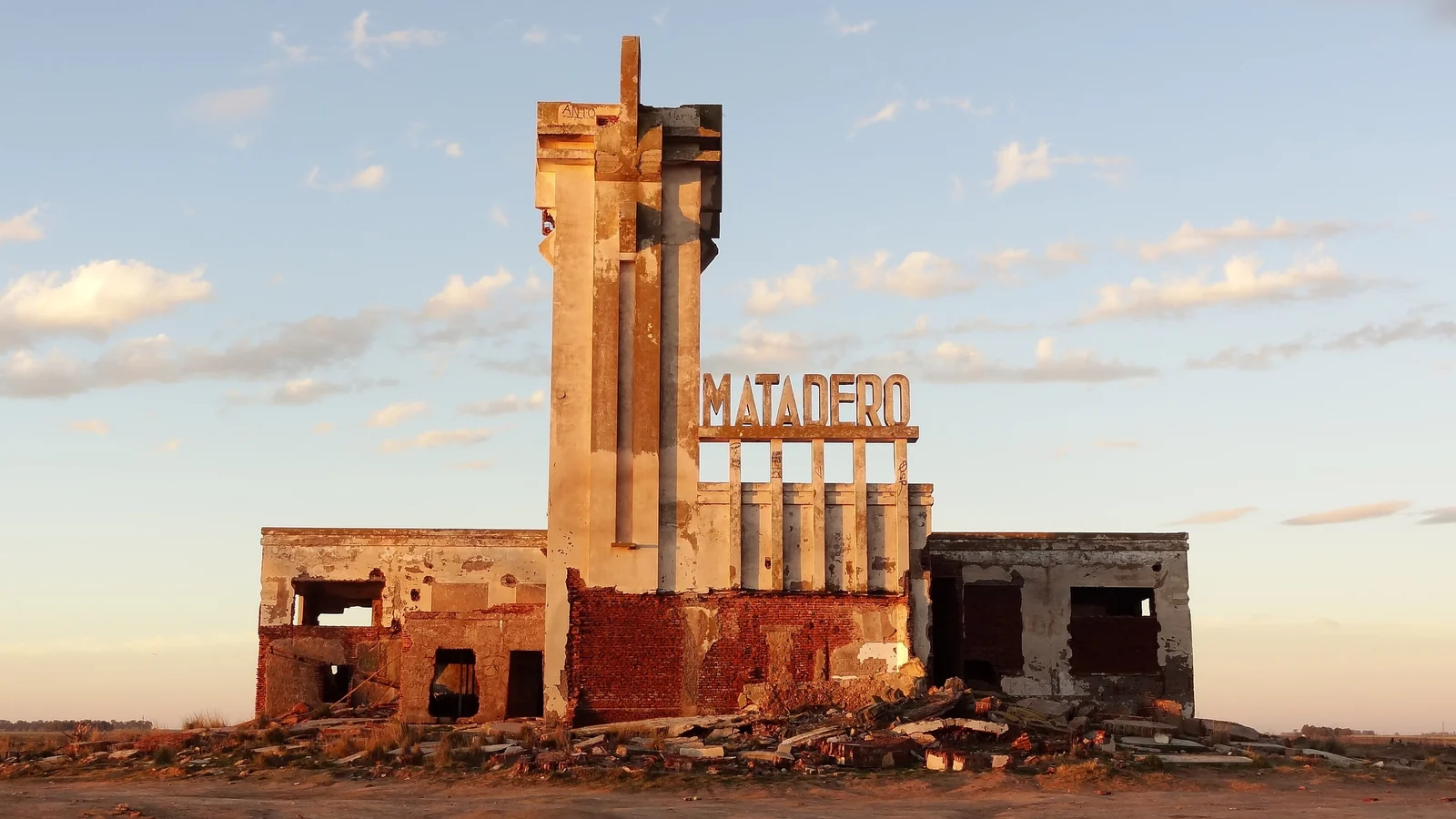
The most photographed building is the former municipal slaughterhouse near the entrance, designed by architect Francisco Salamone. It is one of the few structures still fairly intact, with a tall concrete tower and the word MATADERO in big block letters. It looks like a film set, and for once the set is real.
Dead trees and the salt-white streets
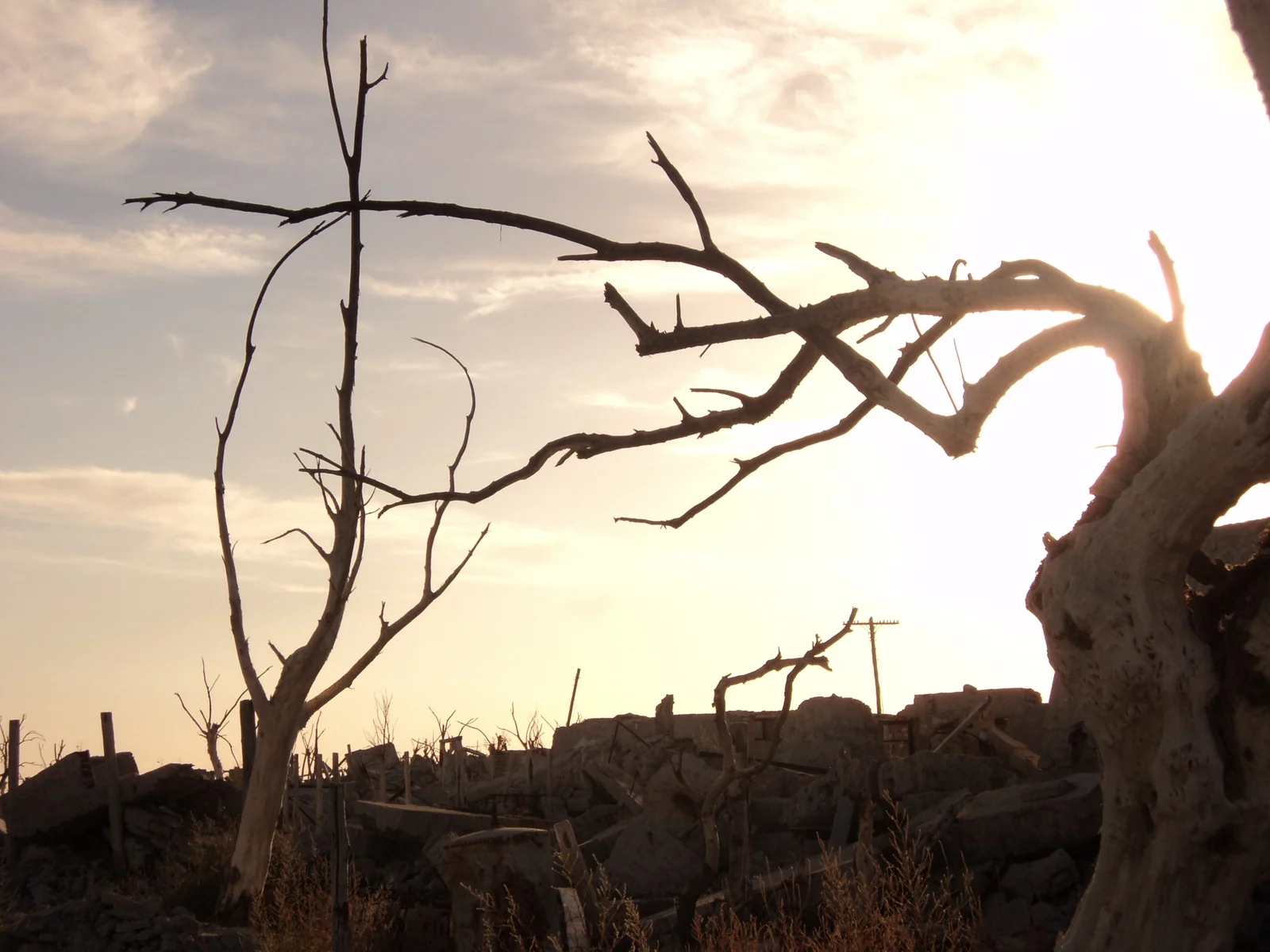
Walk the old avenues and you pass rows of leafless trunks, bleached by years of brine. They are the quietest part of the place and, honestly, the most affecting. Between them lie slabs of fallen concrete, rusted ironwork and crumbled brick, with salt crystals dusting the ground in dry weather.
Concrete shells and hotel foundations
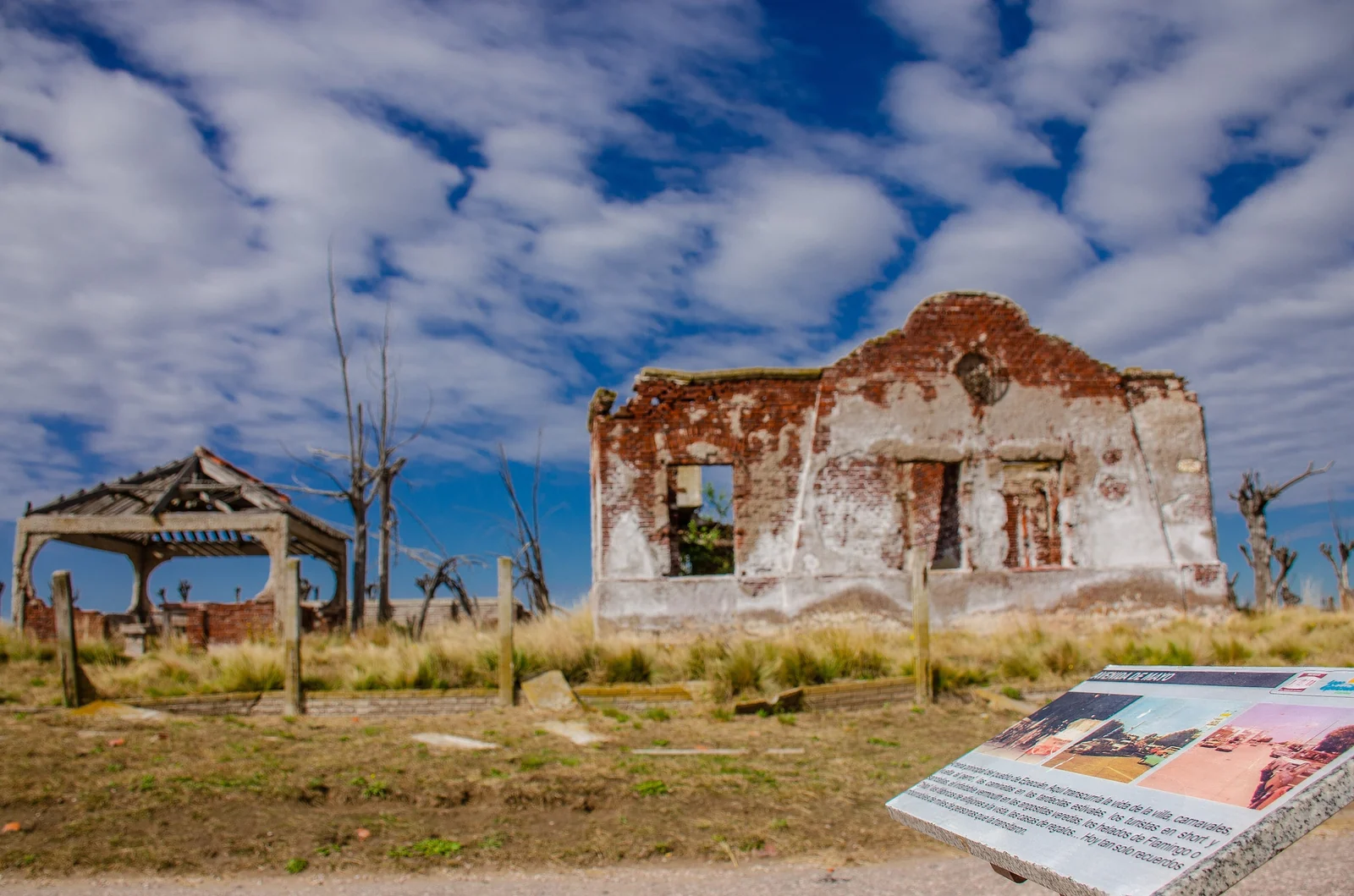
Many buildings survive only as outlines: doorways with nothing behind them, steps that lead nowhere, foundations of former shops and baths. Information panels along the route show photographs of the same streets in the resort years, and comparing the two is half the point of the visit.
The cemetery area and the edges of the site
Some accounts mention an old cemetery zone and outlying ruins. I could not confirm which parts are open or marked, so ask staff at the entrance. Treat any grave or burial structure as a place where people are remembered, not as a photo prop.
Best Time of Day, Season and Weather
Light decides the mood here. Salt-white ruins in harsh midday sun can look washed out, with glare coming off the ground. Early morning and the last hours before sunset give warm side-light, long shadows and fewer people, and the dead trees look best against a low sun.
| Time | Light and mood | Practical note |
|---|---|---|
| Early morning | Soft, cool, quiet | Best for photos and for walking without a crowd |
| Midday | Flat, bright, hot in summer | Bring shade, water and a hat |
| Late afternoon | Warm and golden | Good for the slaughterhouse and the tree silhouettes |
The old resort season ran from November to March, so summer is when Carhué is liveliest and the spa side feels most like a holiday. Outside those months it is calmer and cooler, and the ruins are just as strong. The Pampas wind can be fierce in any season, so bring a jacket and hold on to your hat.
The Salt Lake, the Spa and Other Pampas Stops
Lago Epecuén is still there, and its water is still very salty. The thermal waters are the reason Carhué kept its spa tradition, and there are thermal facilities near the shore. Operators offer baths and treatments, and some also run guided visits to the ruins; check with them directly for current options and rules.
A float is worth considering after a long day among the rubble. The water is far saltier than most people expect, so keep it away from your eyes, skip it if you have cuts or sensitive skin, and rinse off afterward. If you have a medical condition, ask a professional before using mineral baths.
Other stops across the Pampas
Part of the pleasure of this trip is the road itself. The Pampas are a huge, almost treeless plain of farms, small towns and big skies, and a day here is a good counterweight to the capital. Stopping in a country town for lunch, wandering a plaza or watching the light change over wheat and cattle country costs very little.
Rather than invent a list of attractions I cannot check, I would suggest asking at the Carhué tourism office about nearby lakes, birdlife and local museums. Combine them with the ruins and the spa, and you have a satisfying two-day loop.
Safety, Respect and Practical Tips
This was a real town. People lost their homes, and many stayed attached to the place for decades. Keep that in mind when you climb around.
- Stay on marked paths. Walls and slabs are unstable, and salt-crusted ground can hide holes and rebar.
- Do not climb on structures. An injury here is a long way from a hospital, and climbing speeds up the damage.
- Take nothing and leave nothing. No souvenirs from the ruins, no graffiti, no litter.
- Bring water, sun protection and sturdy shoes. There is almost no shade, and the wind dries you out.
- Ask before using a drone. Rules vary, and a quiet place should stay quiet.
Tell someone your plan, carry a charged phone and keep your Carhué address handy, since the plain is wide and empty.
How It Compares With Other Abandoned Places
Villa Epecuén belongs on a list with other ghost sites, but it is unlike most of them. The nitrate town of Humberstone in Chile was a company town closed by economics; here, a lake took the town in one season and held it for a generation. Kolmanskop in Namibia is sand swallowing houses slowly, while Epecuén is salt water that left everything bleached but standing.
Gunkanjima is a concrete island city reached by boat, and the ghost towns of Scotland are quiet cottages sinking into the moor. Epecuén is flatter, brighter and more open than any of them. If big empty horizons are your thing, the same feeling carries far south, which we cover in our piece on glaciers and mountains in Patagonia.
Practical checklist
- Allow half a day for the ruins, plus extra time if you want a spa session in Carhué.
- Pay the entry fee at the municipal office and confirm hours before you drive out.
- Carry some cash as a backup; small shops and services may not take cards.
- Wear closed shoes and long trousers for the rubble.
- Pack a light jacket even in summer, because the wind picks up in the afternoon.
- Fill your tank and buy water in Carhué before you head to the site.
For background and to cross-check the timeline, see the Villa Epecuén reference entry, and ask the local tourism office in Carhué what is open on the day.
Villa Epecuén FAQ
Is Villa Epecuén worth visiting?
Yes, if you enjoy ruins and unusual landscapes. The dead trees, salt-white streets and the intact slaughterhouse tower make a strong half-day, especially in good light. It is a long way from the capital, so combine it with a night in Carhué and the spa.
Why was Villa Epecuén flooded?
On 6 November 1985, a rare weather-driven oscillation of the lake broke a nearby dam and then the protective dike. The water rose to around 10 m at its peak and covered the resort. The village was never rebuilt after that.
How far is Villa Epecuén from Carhué?
The ruins are roughly 7 to 8 km from the center of Carhué, so a short drive or bicycle ride. Carhué itself is about 520 km from Buenos Aires, which is why most visitors plan a full travel day or an overnight stay.
Can you swim in Lago Epecuén?
The lake is known for its very salty, mineral-rich water, and Carhué has thermal facilities near the shore. Ask at the spa about current rules and conditions, keep the water out of your eyes, and check with a doctor if you have health concerns.
Do you need a guide?
No, you can walk the marked routes on your own after paying the entry fee in Carhué. A guide adds history and context, and some spa operators offer visits. Confirm availability locally rather than relying on an old listing.
What is the best time of day to visit?
Early morning and late afternoon. The low sun warms the bleached walls, softens the glare off the salt and makes the dead trees stand out. Midday is bright and hot in summer, with little shade anywhere on the site.
Who was Pablo Novak?
Pablo Novak, born in 1930, was the last resident of Villa Epecuén. He returned to his home after the water receded and lived among the ruins until his death in January 2024. He also appeared in the 2013 documentary Pablo's Villa.