


Puglia (Apulia in English) is the heel of the Italian boot, a long, flat-ish region of olive groves, whitewashed hill towns and two seas: the Adriatic to the east and the Ionian to the southwest. It is one of the best parts of Italy for a road trip, because the highlights are spread out and the roads between them are easy.
This Puglia travel guide follows the classic route south from Bari: cliff-top Polignano a Mare and Monopoli, the trulli country of the Valle d'Itria, a detour to Matera, baroque Lecce and the Salento coast down to Santa Maria di Leuca. Give it a week at minimum, ten days if you want beach time. For the bigger picture, see our overview of the wonders of Italy.
Bari, Polignano a Mare and Monopoli
Bari Vecchia
Most trips start in Bari, the regional capital. Don't leave straight from the airport: give the old town, Bari Vecchia, at least half a day. Its tangle of limestone lanes sits on a small peninsula, and it still feels like a neighborhood rather than a museum.
The anchor is the Romanesque Basilica di San Nicola, built to house the relics of Saint Nicholas, which sailors from Bari carried off from Myra in Asia Minor in 1087. Nearby, on and around Strada Arco Basso, local women roll and shape orecchiette by hand at tables set up in their doorways. Buy a bag if you stop to watch.
Polignano a Mare
Half an hour south, Polignano a Mare sits on limestone cliffs riddled with sea caves. The view everyone comes for is Lama Monachile, a pebbly cove squeezed between two walls of rock, crossed by an old bridge on the coast road. Walk the lanes of the old town to the balconies that hang over the water, and look for the statue of Domenico Modugno, the singer of "Volare", who was born here.
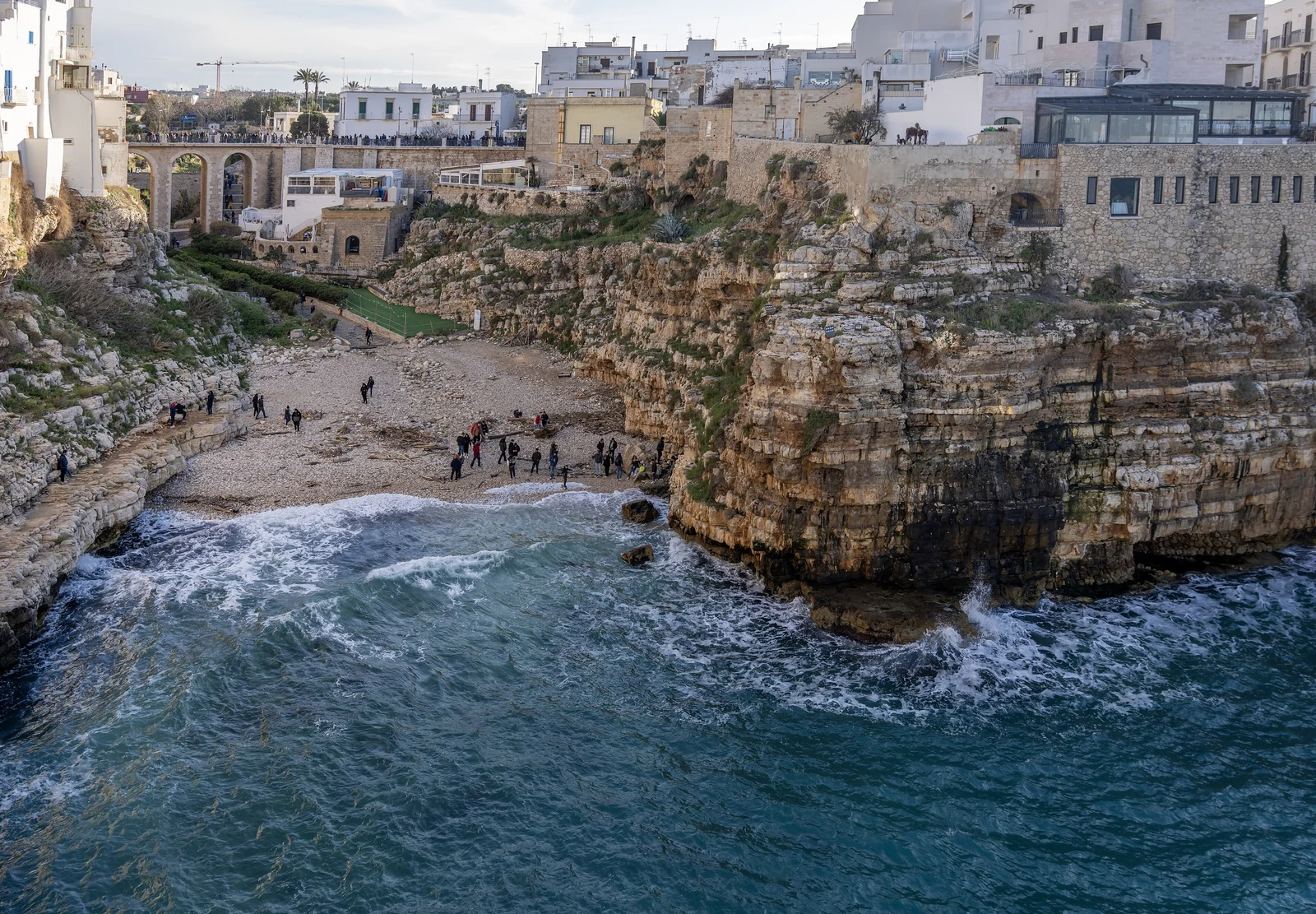
Polignano gets crowded on summer weekends. Come early, or stay for the evening when the day-trippers leave.
Monopoli
Monopoli is the better base of the two, in my view. It has a larger old town, a working harbor full of blue wooden fishing boats, a seafront castle and a string of rocky coves and small sandy beaches to the south. It also has trains to Bari, and it puts you within half an hour of the Valle d'Itria.
The Valle d'Itria: Trulli and White Towns
Inland from Monopoli, the land rises onto a low plateau of dry-stone walls, vineyards and olive trees, dotted with trulli, the round limestone huts with conical roofs that have become Puglia's emblem. Its towns sit close together, so you can see three in a day without rushing.
Alberobello
Alberobello has the densest concentration of trulli anywhere, and the Trulli of Alberobello have been a UNESCO World Heritage Site since 1996. The roofs are built of corbelled limestone slabs laid without mortar, and many are painted with white symbols.
The town has two trulli quarters. Rione Monti, on the hillside, is the famous one and is largely given over to souvenir shops. Rione Aia Piccola, across the main road, is quieter and still lived in. See both, and climb to one of the rooftop terraces for the view over the cones. Arrive before 10 a.m. or after 5 p.m. to dodge the tour buses.
Locorotondo and Cisternino
Locorotondo is the prettiest of the trio, a circular old town of white houses with pointed gable roofs, called cummerse, and flowers on every step. The local DOC white wine is light and easy, ideal with lunch. Cisternino, a short drive away, is famous for its fornelli pronti: butcher shops that grill the meat you choose and serve it at tables outside. Go in the evening and order bombette, small rolls of pork stuffed with cheese.
Ostuni, the White City
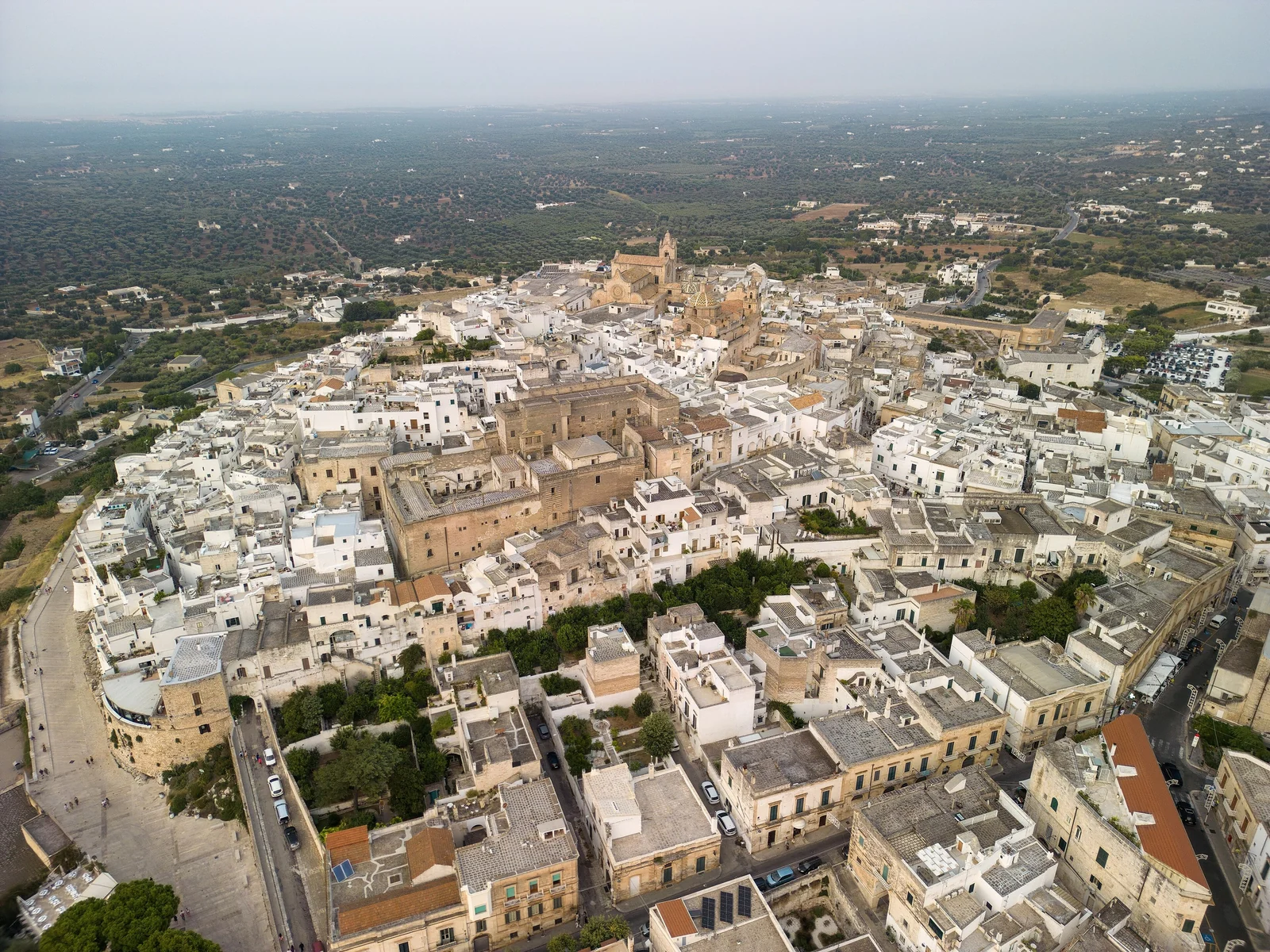
Ostuni spills over a hill above a plain of ancient olive trees, with the Adriatic on the horizon. Its old town is whitewashed almost entirely, which is why it is called La Città Bianca. Climb to the Gothic cathedral at the top, then get lost on the way down; the lanes and stairways are the attraction.
Matera: A Side Trip to Basilicata
Strictly speaking, Matera is not in Puglia. It sits just over the border in Basilicata, but it is so close to Bari and Alberobello that almost every Puglia road trip includes it, and it would be a shame to skip it.
The town's Sassi are two districts of cave dwellings, rock-cut churches and houses stacked up the side of a ravine. People lived in them for thousands of years, until the 1950s, when the government moved residents out over poor living conditions. Restored, the Sassi and the Park of the Rupestrian Churches joined the UNESCO list in 1993, and Matera was a European Capital of Culture in 2019.
A day trip works, but Matera is at its best after dark, when the lights come on across the ravine. Spend a night if you can, and wear shoes with grip.
Baroque Lecce
Lecce is the cultural capital of the south and my favorite city in the region. Its old town is a showcase of barocco leccese, a local baroque style carved from the soft, honey-colored limestone called pietra leccese. The stone is easy to work when freshly quarried, which explains the almost absurd detail on the facades.
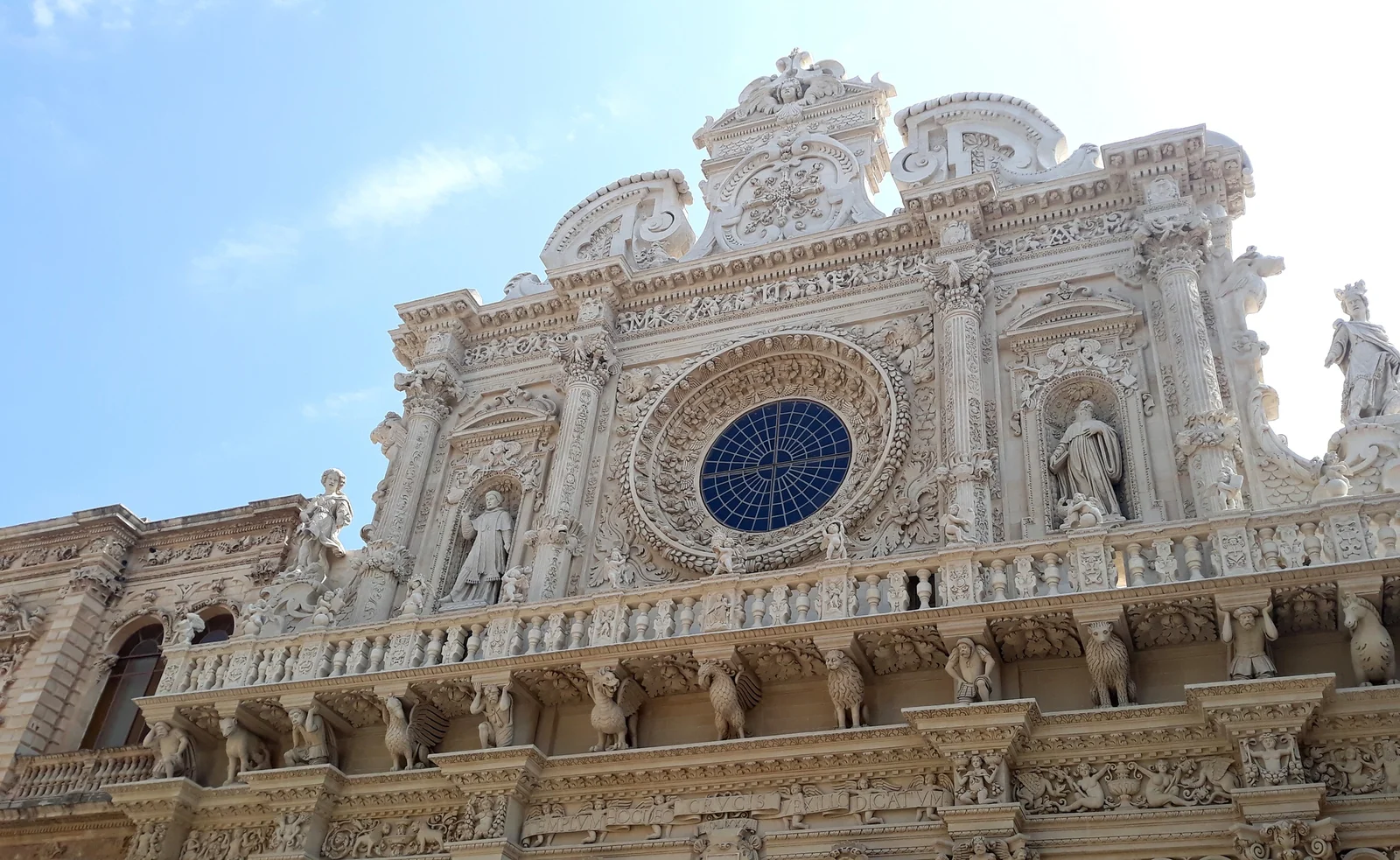
Start at the Basilica di Santa Croce, whose facade is crowded with cherubs, animals, fruit and grotesque figures around a great rose window. Then walk to Piazza del Duomo, an enclosed square that comes as a surprise when you step into it, and to Piazza Sant'Oronzo, where part of a Roman amphitheater lies below street level.
Try a warm pasticciotto, a custard-filled pastry, for breakfast and a caffè leccese, espresso over ice with almond syrup, in the afternoon. Two nights is a good minimum, and Lecce makes a handy base for both Salento coasts.
The Salento Coast: Otranto, Leuca and Gallipoli
South of Lecce, the Salento peninsula narrows to a point. A loop around it, east coast first, makes one of the best driving days in Italy: about 150 km if you go straight through, though it is better split over two or three days with swims along the way.
Otranto
Otranto, Italy's easternmost town, is a walled port with clear, shallow water right below the old town. Inside the cathedral, the 12th-century floor mosaic of a vast Tree of Life mixes biblical scenes, zodiac signs and a figure of King Arthur. A chapel holds the bones of the Martyrs of Otranto, killed when an Ottoman force took the town in 1480.
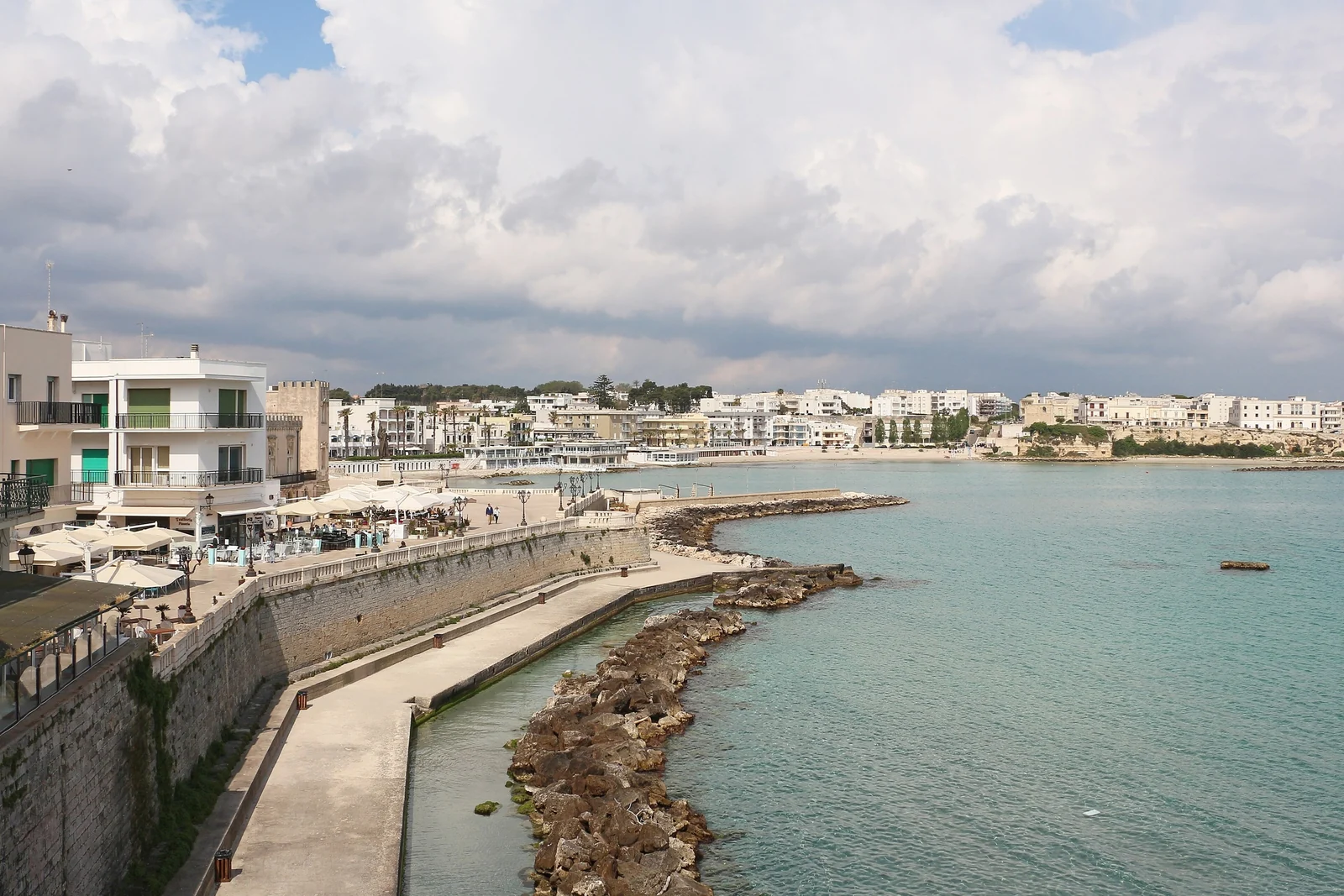
North of town, on the way from Lecce, look for the sea stacks of Torre Sant'Andrea and the Grotta della Poesia, a natural swimming hole near Roca. South of Otranto the road climbs along cliffs to Castro and the inlets around Tricase. Stop wherever you see cars parked by a stair down to the rocks.
Santa Maria di Leuca
At the tip of the heel, Santa Maria di Leuca has a lighthouse, a basilica on the headland and a seafront of 19th-century villas. Boat trips run to the sea caves along the cliffs in the warmer months.
Gallipoli
On the Ionian side, the old town of Gallipoli sits on a small limestone island joined to the mainland by a bridge. Walk its walls at sunset and spend a day on the long sandy beaches to the south. In August it is a party town; outside summer it is calm.
What to Eat in Puglia
Puglian food is simple, based on vegetables, durum wheat, seafood and some of the best olive oil in Italy. Puglia produces more olive oil than any other Italian region, and you taste it in nearly everything.
- Orecchiette: the ear-shaped pasta of Bari, classically served con cime di rapa, with turnip greens, garlic, chili and anchovy.
- Burrata: a pouch of fresh mozzarella filled with cream and shredded curd, associated with Andria in the north of the region. Eat it the day it is made.
- Focaccia barese: a thick, oily focaccia topped with cherry tomatoes and olives, often made with potato in the dough. Bakeries sell it by the slice.
- Wine: Primitivo from Manduria and Gioia del Colle, Negroamaro from the Salento, and plenty of rosato.
Where to Stay: Masserie and Town Bases
A masseria is a fortified farmhouse, built around a courtyard, sometimes with a defensive tower, from the days when farms in the countryside had to protect themselves. Many have been converted into places to stay, from simple agriturismi serving their own produce to luxury hotels with pools in the olive groves. A night or two in one is a highlight of any Puglia trip.
- Monopoli or Polignano: for Bari, the coast and the Valle d'Itria.
- Ostuni, Locorotondo or a masseria nearby: for trulli country and countryside evenings.
- Lecce: for the baroque city and day trips to both Salento coasts.
- Otranto or Gallipoli: if beaches matter more than city life.
Best Time to Visit Puglia
Puglia has hot, dry summers and mild winters. Spring and early autumn are the best balance of warmth, open restaurants and quieter roads.
- May, June and September: the sweet spot. The sea is warm enough to swim by June and stays warm through September.
- July and August: very hot, with the busiest beaches and highest prices. Mid-August, around the Ferragosto holiday, is when Italians are on vacation, so book early.
- October: often still mild, with grape and olive harvests and fewer visitors.
- November to March: quiet and cool. Good for Lecce, Bari and Matera, but many seaside hotels and beach clubs close.
Getting There, Driving Tips and ZTL Zones
Puglia has two main airports: Bari (BRI), the busier one, and Brindisi (BDS), closer to Lecce and the Salento. Flying into one and out of the other saves backtracking. High-speed trains also run to Bari and Lecce from Rome and the north. You can reach the big towns by train, including Alberobello and Locorotondo on the local Ferrovie del Sud Est line, but a rental car is by far the easiest way to see the region.
Distances on a Classic Route
| Leg | Approx. distance | Approx. driving time |
|---|---|---|
| Bari to Polignano a Mare | 35 km | 35 to 45 minutes |
| Polignano to Alberobello | 30 km | 35 minutes |
| Alberobello to Matera | 70 km | 1 hour 15 minutes |
| Alberobello to Ostuni | 45 km | 50 minutes |
| Ostuni to Lecce | 75 km | 1 hour |
| Lecce to Otranto | 45 km | 45 minutes |
| Otranto to Santa Maria di Leuca (coast road) | 50 km | 1 hour 10 minutes |
| Leuca to Gallipoli | 45 km | 50 minutes |
How ZTL Zones Work
Almost every historic center in Puglia, including Bari, Lecce, Ostuni, Polignano, Monopoli and Gallipoli, is a ZTL (zona a traffico limitato), a limited traffic zone. A round sign with a red border marks the entrance, often with an electronic panel showing "varco attivo" when the cameras are on. Drive past it without a permit and a camera records your plate.
Fines arrive by mail, often months later, and the rental company adds its own admin fee for passing on your details. If your hotel is inside a ZTL, ask it to register your plate with the local police before you arrive. Otherwise, park outside the center and walk.
More Driving Tips
- Rent a small car. Old-town lanes and masseria tracks are narrow, and parking is tight.
- Learn the line colors. Blue lines mean paid parking (pay at the machine or by app), white lines are usually free, and yellow lines are reserved.
- Expect some tolls. The A14 autostrada runs down the coast as far as Taranto, while most of the route south of Bari uses free four-lane roads such as the SS16.
For events and current visitor information, the region's official tourism site, Viaggiare in Puglia, is a good starting point. If you are extending the trip, our guide to the islands of Italy has ideas for the next leg, and you can browse all our Italy travel guides. Planning a longer trip? Browse more European destinations.
Puglia Travel FAQ
How many days do you need for a Puglia road trip?
A week covers Bari, Polignano, Monopoli, the Valle d'Itria, Lecce and a quick look at the Salento coast. Ten days gives you time for Matera, a night in a masseria and proper beach days around Otranto and Gallipoli without long daily drives.
Is Matera in Puglia?
No. Matera is in Basilicata, just across the regional border, about an hour by car from Bari or Alberobello. Because it is so close, it is usually included in Puglia itineraries as a day trip or, better, an overnight stop.
Do you need a car in Puglia?
A car makes the trip much easier, especially for the Valle d'Itria countryside, masserie and Salento beaches. Trains link Bari, Monopoli, Ostuni, Brindisi and Lecce, and a local line serves Alberobello and Locorotondo, but connections to smaller places can be slow.
What is a ZTL in Italy?
A ZTL, or zona a traffico limitato, is a limited traffic zone, usually in a historic center. Cameras record cars entering without a permit, and fines are mailed to you via your rental company. Watch for round red-bordered signs and park outside.
Is Alberobello worth visiting?
Yes, though it is busy. Its two trulli quarters are a UNESCO World Heritage Site and there is nothing quite like them. Visit early or late in the day, see quieter Rione Aia Piccola as well as Rione Monti, and pair it with Locorotondo.
When is the best time to visit Puglia?
May, June and September are the best months, with warm weather, swimmable sea and fewer crowds than in high summer. July and August are hot and busy, and many coastal hotels and beach clubs close between November and March.
Which airport is best for Puglia?
Bari is best for the north, the Valle d'Itria and Matera, while Brindisi is closer to Lecce and the Salento. Flying into one and out of the other lets you drive the region north to south without backtracking.