


The Cotswolds is a long ridge of limestone hills in south-central England, roughly between Bath in the south and Chipping Campden in the north, with Oxford off to the east. It is the England of stone cottages, sheep pasture, market squares and old coaching inns, and most of it sits within easy reach of London by train.
Go for the villages, but stay for the walking. This Cotswolds travel guide covers which villages earn their reputation and which get overwhelmed, the best short walks and the Cotswold Way, how to get around without losing half your day to logistics, and a realistic three-day route.
Where Are the Cotswolds, Exactly?
There is no single border sign. The protected area, officially the Cotswolds National Landscape, covers about 790 square miles across parts of Gloucestershire, Oxfordshire, Wiltshire, Somerset (around Bath), Warwickshire and Worcestershire. It is the largest of England's National Landscapes, the name every Area of Outstanding Natural Beauty adopted in November 2023. The legal designation is still AONB, so you will see both terms on maps and older signs.
Think of it in two halves. The North Cotswolds, around Chipping Campden, Broadway, Stow-on-the-Wold and Bourton-on-the-Water, holds most of the famous names and most of the coach traffic. The South Cotswolds, around Cirencester, Tetbury, Painswick and down toward Castle Combe and Bath, is more spread out and generally calmer. Trying to see both in a weekend is the classic mistake.
Expedia named the Cotswolds one of its 2026 Destinations of the Year, so plan around crowds rather than hoping to avoid them.
Why Cotswold Villages Look the Way They Do
Two things built the Cotswolds: rock and sheep. The hills are made of Jurassic oolitic limestone, a stone that contains iron oxide and weathers to anything from pale cream to deep honey. In the north it tends toward gold; farther south it often looks grayer and cooler. Because the stone was quarried locally, whole villages match their own fields and walls.
The money came from wool. In the Middle Ages, fleece from the long-haired Cotswold Lion sheep made this one of the richest corners of England. Merchants poured their profits into oversized parish churches, known as wool churches, in places like Cirencester, Northleach and Chipping Campden. When the wool trade faded, many towns simply stopped growing, so much of what you see survived without later rebuilding.
Best Villages in the Cotswolds (and How Busy They Get)
Every village below is worth a stop, just not always at 1 p.m. on a sunny Saturday in August. The more famous the photograph, the earlier you should arrive.
Bibury and Arlington Row
Arlington Row is probably the most photographed scene in the region. The cottages are believed to date from around 1380, when they were built as a monastic wool store, and were converted into weavers' homes in the 17th century. Wool was hung to dry on racks on the water meadow opposite, still called Rack Isle. Today the row is owned by the National Trust, and most cottages are private homes.
Bibury is small, with tight parking. Come before 9 a.m. or after 5 p.m., take your picture from the lane, and walk along the River Coln instead of waiting for an empty frame.
Castle Combe
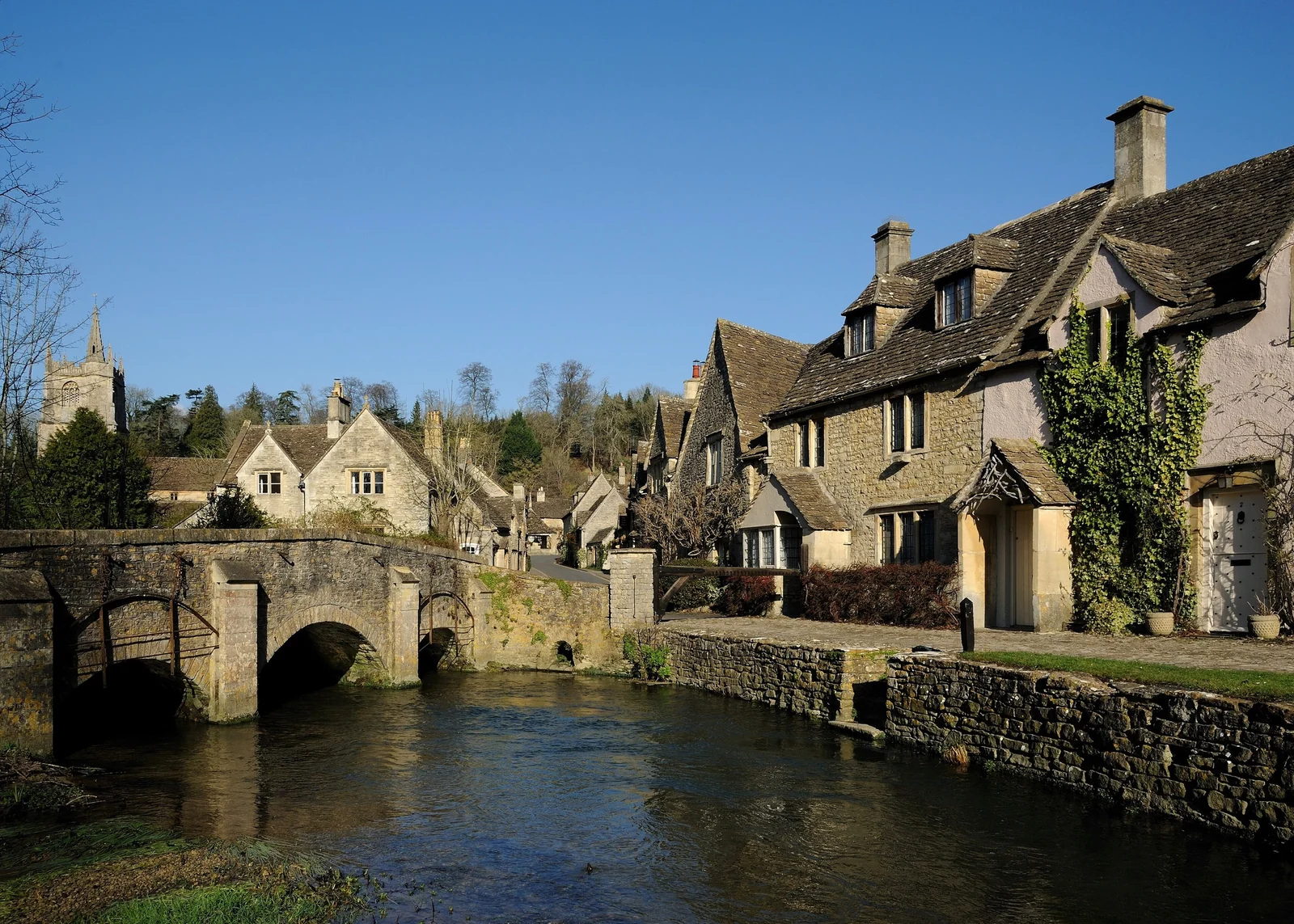
At the southern tip of the Cotswolds in Wiltshire, Castle Combe is a single street of stone houses running down to an old bridge over the By Brook. Steven Spielberg filmed scenes for War Horse here. Visitors park in the car park on the hill above the village and walk down, about ten minutes. The lanes have no sidewalks and fill quickly on bank holidays, so a weekday visit makes a real difference.
Bourton-on-the-Water
Bourton has the River Windrush running shallow through its green, crossed by low stone footbridges, which explains the nickname Venice of the Cotswolds. It is also the busiest village in the region and can feel like a theme park by midday. Go early in the morning or in the early evening, when the day-trippers have left and the river is quiet.
Upper and Lower Slaughter
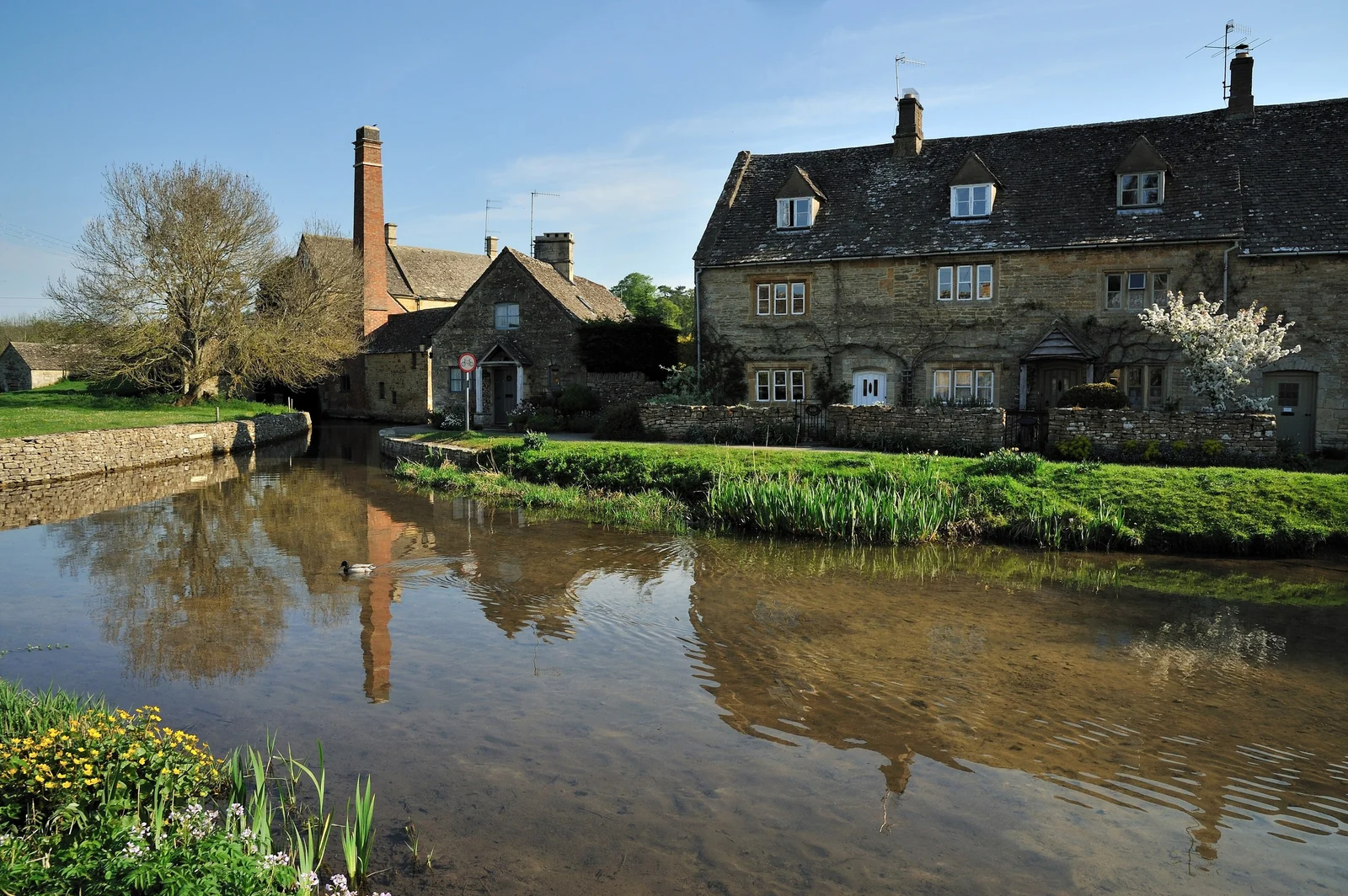
Just north of Bourton, these two villages are the antidote. Lower Slaughter has a brick-chimneyed mill on the little River Eye; a footpath from behind the mill follows the stream for about a mile to Upper Slaughter, which is quieter still. The name has nothing to do with violence; it is generally traced to an Old English word for a muddy place.
Stow-on-the-Wold
At around 800 feet, Stow is the highest town in the Cotswolds, and its big market square is a reminder of how much trade passed through it. Look for the north door of St. Edward's Church, framed by two ancient yews growing into the stonework. Tolkien fans say it inspired the Doors of Durin, though that is local lore rather than documented fact.
Chipping Campden
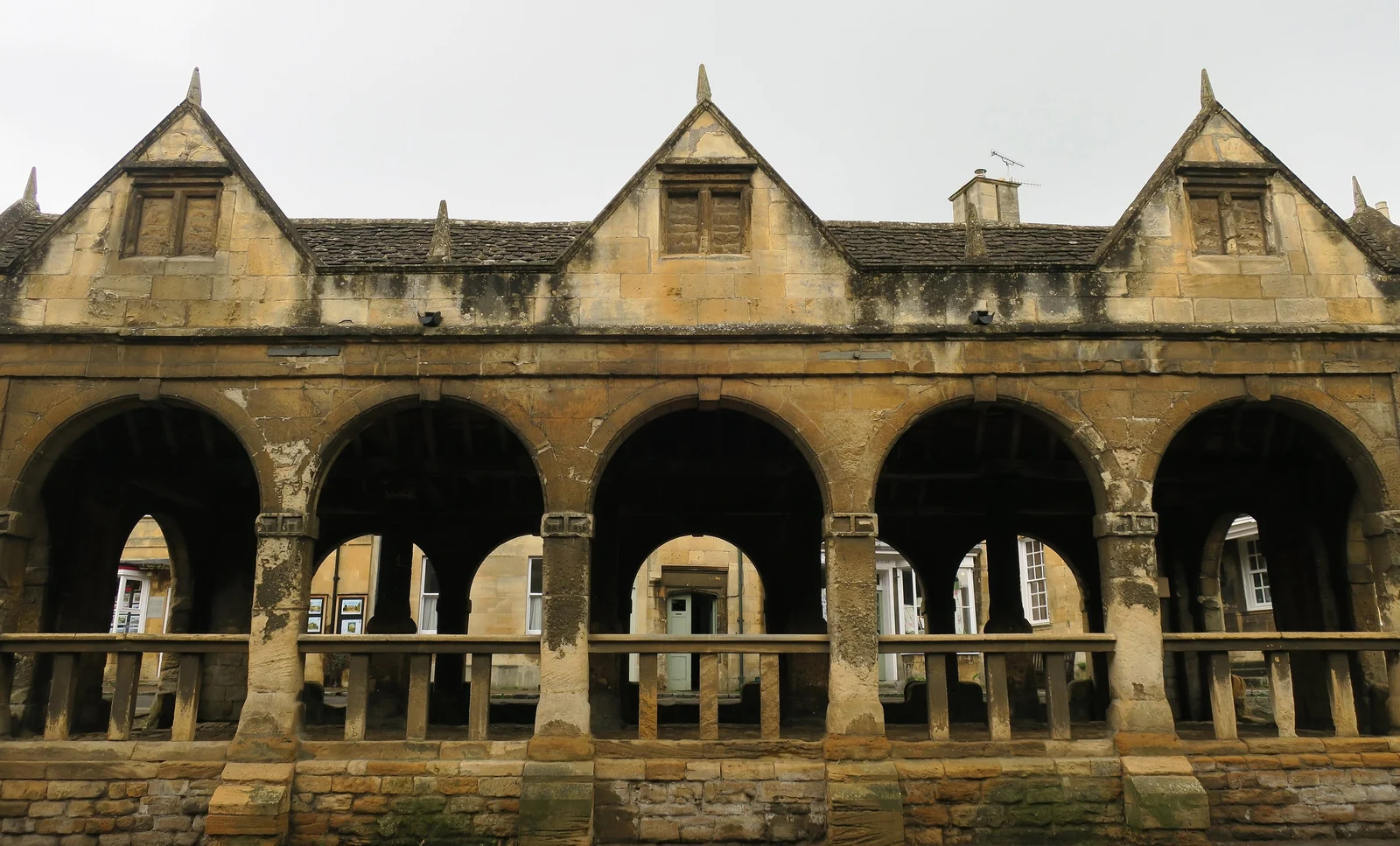
If you only see one wool town, make it this one. The curving High Street is almost entirely historic, anchored by the arched Market Hall built in 1627. St. James' Church is a classic wool church, and inside is a memorial brass to William Grevel, described there as the flower of the wool merchants of all England. Campden also marks the northern start of the Cotswold Way.
Broadway and Broadway Tower
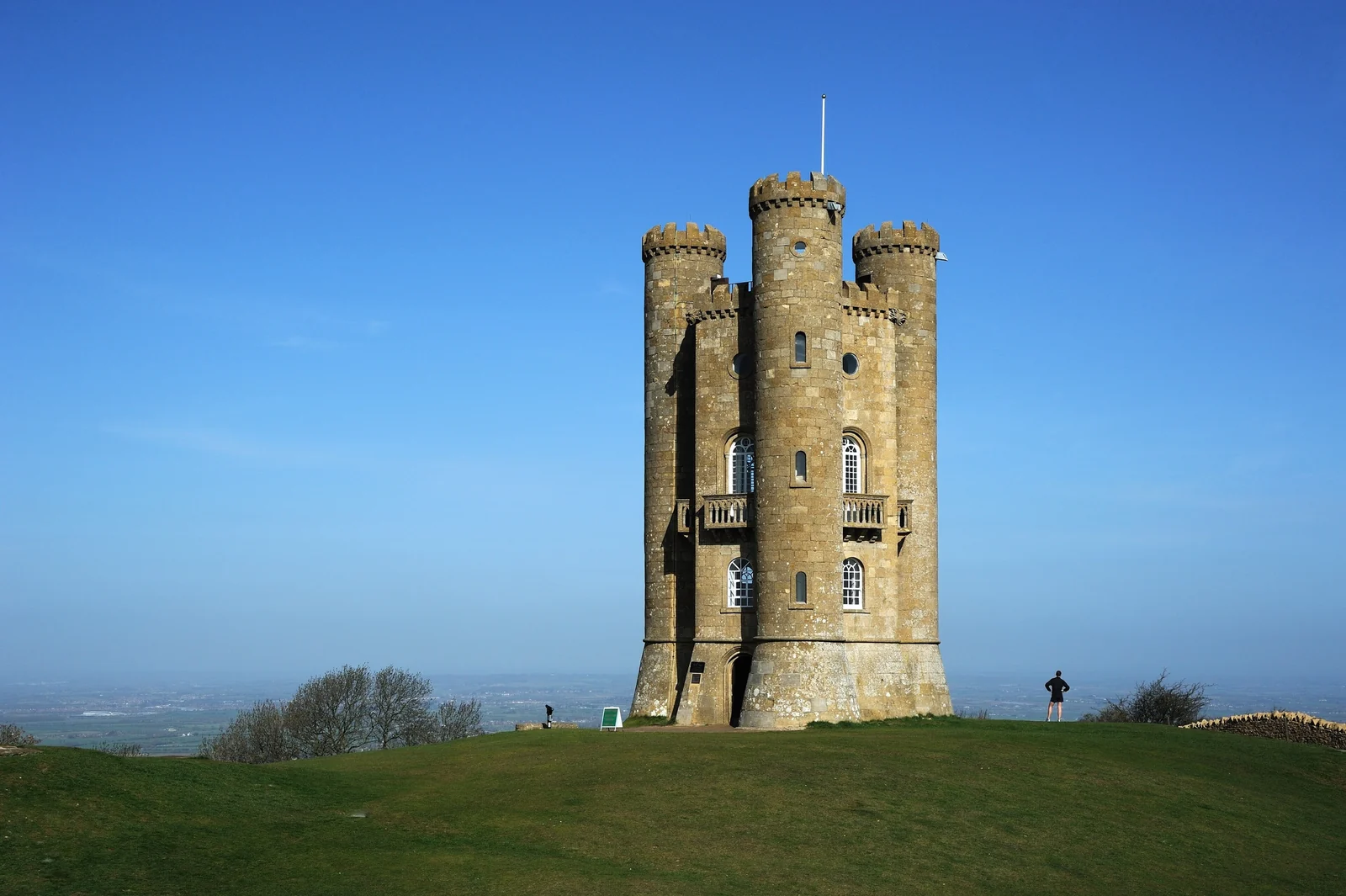
Broadway's wide, tree-lined main street is polished and a little upmarket, with galleries and tearooms. Above it, on Broadway Hill at about 1,024 feet, stands Broadway Tower, a 65-foot folly. Capability Brown came up with the idea; James Wyatt designed and completed it in 1798. On a clear day the view across the Vale of Evesham is superb.
Painswick
Often called the Queen of the Cotswolds, Painswick sits on a hillside above the Stroud valleys and is far less crowded than the northern stars. Its churchyard is famous for its clipped yew trees, traditionally counted at 99. Just outside the village, Painswick Rococo Garden is a rare survivor of an 18th-century style of garden that almost vanished elsewhere in England.
Burford
Burford's High Street drops steeply to the River Windrush, lined with stone houses, inns and independent shops. Coming from Oxford by road, it is the natural first stop. Walk all the way down to the medieval church near the river; most people turn back halfway.
Tetbury
In the south, Tetbury is a working market town known for its antique shops. Its Market House, raised on stone pillars in 1655, was built for the wool and yarn trade, and Highgrove, the private home of King Charles III, is just outside town.
| Village | Best for | Crowds | Tip |
|---|---|---|---|
| Bibury | Arlington Row, river walk | Very high at midday | Arrive before 9 a.m. |
| Bourton-on-the-Water | Riverside green, families | Highest in the region | Visit in the early evening |
| Lower and Upper Slaughter | Short stream-side walk | Moderate | Walk in from Bourton |
| Chipping Campden | Wool town architecture | Moderate | Pair with Hidcote |
| Broadway | Tower views, galleries | High on weekends | Walk up to the tower |
| Castle Combe | Classic village street | High on bank holidays | Go on a weekday |
| Painswick | Quiet streets, yews, garden | Low | Combine with the Cotswold Way |
| Tetbury | Antiques, market town life | Low to moderate | Base for the south |
Best Walks in the Cotswolds
Footpaths here are well marked, distances are short, and most routes end near a pub. Wear proper shoes anyway; field paths turn to mud quickly after rain.
The Cotswold Way National Trail
The Cotswold Way runs 102 miles (164 km) from Chipping Campden to Bath, mostly along the western escarpment, where the hills drop to the Severn Vale. Most walkers take seven to ten days. It climbs on and off the edge again and again, so it is harder than the gentle scenery suggests. If you only have a day, the opening stretch from Chipping Campden over Dover's Hill toward Broadway Tower gives you the best of it.
Shorter Village-to-Village Walks
- Bourton to the Slaughters: about 1.5 miles across fields to Lower Slaughter, then a mile along the River Eye to Upper Slaughter. A full circular loop back to Bourton is roughly five miles.
- Stow-on-the-Wold to Bourton: around four miles one way, mostly downhill, through the Slaughters. Take the bus back.
Palaces, Castles and Gardens Near the Villages
Blenheim Palace
On the eastern edge of the Cotswolds at Woodstock, Blenheim Palace was built between 1705 and 1722 and became a UNESCO World Heritage Site in 1987. Winston Churchill was born here. Allow most of a day; the Capability Brown parkland deserves a long walk. Hanborough station on the Cotswold Line is the closest by rail.
Sudeley Castle
Beside the small town of Winchcombe, Sudeley Castle is where Katherine Parr, the last of Henry VIII's six wives, is buried, in the chapel of St. Mary in the grounds. The gardens are the main draw. It opens seasonally, roughly spring through autumn, so check dates before you plan around it.
Hidcote
A few miles from Chipping Campden, the National Trust's Hidcote is one of the most influential Arts and Crafts gardens in Britain. Lawrence Johnston created it between 1907 and 1938 as a series of outdoor rooms divided by hedges, each with its own planting.
How to Get to the Cotswolds from London
Great Western Railway runs two useful lines from London Paddington. The Cotswold Line, via Oxford, stops at Hanborough, Charlbury, Kingham and Moreton-in-Marsh, with trains roughly hourly and about 90 minutes to Moreton. For Cirencester, Tetbury and the south, take the line to Kemble. Bath Spa and Cheltenham Spa work for the far southern and western edges. Check times and book on National Rail.
| Station | Line from Paddington | Good for |
|---|---|---|
| Moreton-in-Marsh | Cotswold Line | Stow, Bourton, Chipping Campden, Broadway |
| Kingham | Cotswold Line | Stow, Daylesford, Chipping Norton |
| Charlbury | Cotswold Line | Burford, Wychwood countryside |
| Hanborough | Cotswold Line | Blenheim Palace, Woodstock |
| Kemble | Line toward Gloucester | Cirencester, Tetbury, Bibury |
Car or Bus?
The train gets you to the edge; moving between villages is the hard part, because rural buses are often infrequent. The most useful for visitors is the Pulhams 801, which links Moreton-in-Marsh station with Stow, Bourton and Cheltenham. Build a car-free trip around that corridor and walk the gaps.
A car opens up the south, Hidcote, Snowshill and Castle Combe, but roads are narrow and village parking is limited. Use official car parks, never verges or gateways. Book taxis ahead in small towns.
Best Time to Visit the Cotswolds
Late spring and early autumn are the sweet spot, with gardens open and fewer people than in high summer. May brings blossom; September and October bring color to the beech woods along the escarpment.
Summer has the lavender. Cotswold Lavender at Snowshill, near Broadway, usually opens from mid-June to early August, with the strongest color in July. If you love it, Provence is the next step, and our guide to the charms of Provence covers its lavender country.
Avoid the late May and late August bank holiday weekends if you can; the famous villages and car parks are at their fullest. Winter is quiet, with log fires in the pubs, but some gardens close.
Where to Stay and What to Eat
Pick your base by the half you want to explore. For the north, Chipping Campden, Moreton-in-Marsh and Stow all work; Moreton, with its station, is the easiest without a car. For the south, Cirencester has the most choice. Bath and Cheltenham suit travelers who prefer a city base. Book early for summer weekends.
Food here is pub food done well. Expect Sunday roasts, local lamb, game in autumn and real ales from regional breweries. Farm shops are a highlight; Daylesford, near Kingham, is the best known, but most market towns have smaller ones selling local cheese, bread and cider for a picnic. Many country pubs stop serving food in mid-afternoon, so do not leave lunch too late.
A 3-Day Cotswolds Itinerary
Day 1: Chipping Campden, Hidcote and Broadway
Explore Chipping Campden's High Street and St. James' Church, then walk the Cotswold Way over Dover's Hill to Broadway Tower and down into Broadway. Prefer gardens? Drive to Hidcote instead. In July, add Snowshill's lavender.
Day 2: Stow, the Slaughters and Bourton
Start in Stow's market square, then walk south through the Slaughters to Bourton-on-the-Water, arriving as the crowds thin. The 801 bus takes you back.
Day 3: Bibury, Burford and Blenheim
Be in Bibury by breakfast, before the coaches. Continue to Burford for lunch and a walk down the High Street, then spend the afternoon at Blenheim Palace on your way back toward Oxford and London. With a car and an extra day, swap in Painswick, Tetbury and Castle Combe for a southern loop.
Visiting the Cotswolds Respectfully
These are lived-in villages, not open-air museums. On Arlington Row, stay on the lane, keep off doorsteps and gardens, and do not fly drones over people's homes. Park only in designated spaces; blocked lanes and verges are a constant problem in Bibury, Castle Combe and Bourton.
On footpaths, close gates, keep dogs on leads around sheep and take your litter home. For more trips, browse our Europe guides and United Kingdom travel guides, or head north for something wilder with the abandoned cottages of Scotland.
Cotswolds FAQ
How many days do you need in the Cotswolds?
Two days is enough for a taste of the North Cotswolds. Three days lets you add walks and Blenheim Palace without rushing. With four or five days you can see the quieter south as well, including Painswick, Tetbury and Castle Combe.
Can you visit the Cotswolds without a car?
Yes, if you plan around trains and a few bus routes. Take the train from London Paddington to Moreton-in-Marsh, use the 801 bus to Stow and Bourton, and walk between nearby villages. Castle Combe and Hidcote are much harder without a car.
Which is the prettiest village in the Cotswolds?
Bibury, Castle Combe and Lower Slaughter usually top the lists. For a mix of beauty and atmosphere without constant crowds, Chipping Campden and Painswick are hard to beat.
Is the Cotswolds a national park?
No. The Cotswolds is a National Landscape, the name adopted in 2023 for Areas of Outstanding Natural Beauty in England and Wales. It is still legally an AONB, and at about 790 square miles it is the largest of them.
Can you do the Cotswolds as a day trip from London?
You can, by taking an early train to Moreton-in-Marsh and visiting two or three villages by bus or on foot. It feels rushed, though; one night in Stow, Moreton or Chipping Campden lets you enjoy the villages after the day-trippers leave.
How long does it take to walk the Cotswold Way?
The full 102-mile National Trail between Chipping Campden and Bath usually takes seven to ten days. It involves frequent climbs on and off the escarpment, so plan shorter days than the distance alone suggests.