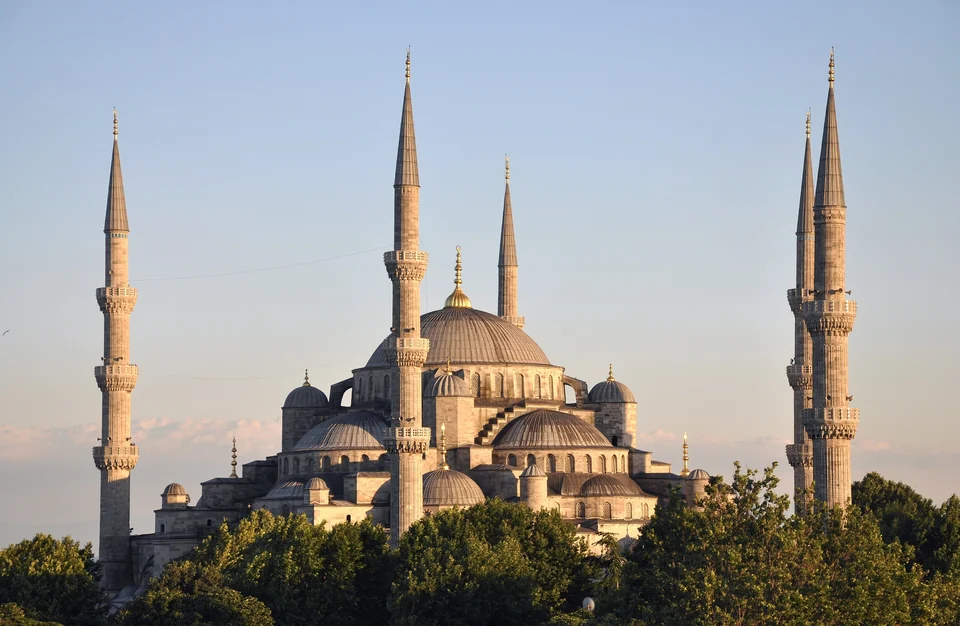



Hagia Sophia (Ayasofya in Turkish) stands on the historic peninsula of Istanbul, facing the Blue Mosque across Sultanahmet Square. Built as a Byzantine cathedral in the 530s, it later became an Ottoman imperial mosque, then a museum, and since 2020 it has again been a working mosque officially named the Hagia Sophia Grand Mosque.
You can still visit, but the rules changed in 2024. Tourists now enter through a separate gate, pay a fee and follow a route through the upper galleries, while the ground floor is reserved for worship. This guide explains the current visiting arrangements, what you will see inside, and the history and engineering that make Hagia Sophia one of the world’s great buildings.
Hagia Sophia Today: A Mosque You Can Visit
In July 2020 a Turkish court annulled the 1934 decree that had turned Hagia Sophia into a museum, and the building reopened for Muslim prayer the same month. For the next few years tourists could walk into the main hall free of charge. That changed on January 15, 2024, when a separate visitor route and an entrance fee for foreign visitors were introduced.
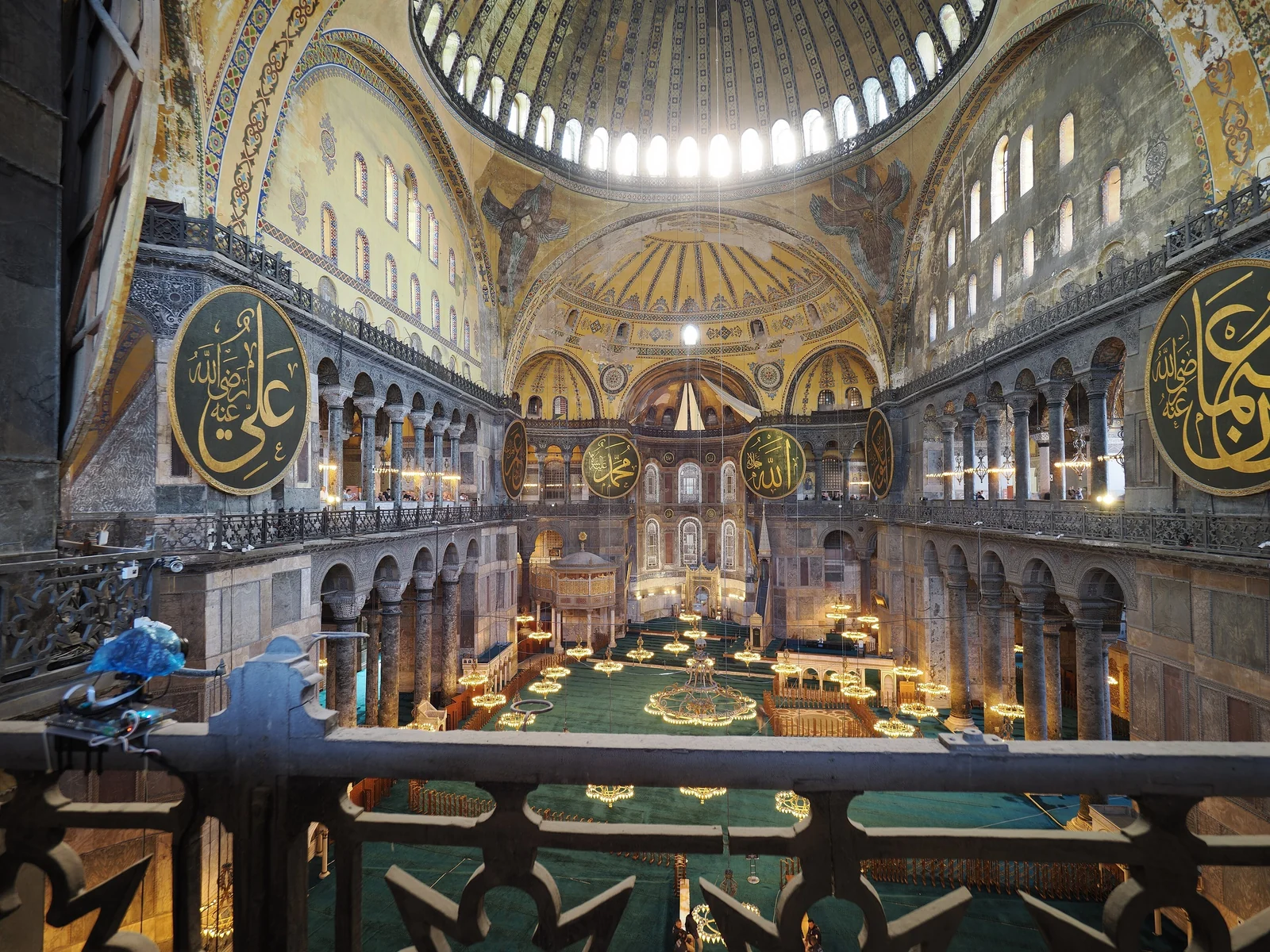
Under the current arrangement, people coming to pray use the worship entrance and the main prayer hall on the ground floor. Visitors enter through a gate opposite the Fountain of Sultan Ahmed III, climb a ramp to the upper galleries where the Byzantine mosaics are, look down into the vast interior, and leave by a separate exit route. Hagia Sophia remains part of the UNESCO World Heritage Site Historic Areas of Istanbul.
Hagia Sophia Tickets, Hours and Rules
The details below come from the official listing of the Istanbul Directorate of Culture and Tourism. They change from time to time, so check the official Hagia Sophia page shortly before your visit.
| Topic | Current arrangement |
|---|---|
| Ticket for foreign visitors | 25 euros, charged in Turkish lira at the day’s rate set by management |
| Free entry | Children under 8 with a passport or ID, accompanied by an adult; worshippers entering to pray |
| Museum Pass Istanbul | Not valid |
| Visiting hours | Roughly 9:00 to 19:30 in the official listing, with changes by season |
| Friday | Closed to visitors around the midday congregational prayer (about 12:00 to 14:00, sometimes longer) |
| Daily prayers | Tourist access can pause briefly during the five daily prayers |
| Where to buy | At the ticket booth or online through the officially authorized seller listed on the official page |
Dress code and etiquette
- Women should cover their hair, shoulders and legs. Headscarves and body covers are sold at the ticket booth for a small fee, but bringing your own is easier.
- Men should wear trousers or shorts that cover the knees, and shirts with sleeves.
- Behave as you would in any mosque: speak quietly, do not walk in front of people praying, and never photograph worshippers.
- Beware of unofficial ticket sellers and people offering to skip the line near the entrance. Buy from the booth or the authorized seller listed on the official page.
A major restoration of the dome and eastern half-dome is under way, and the exterior is largely wrapped in scaffolding. Officials say the mosque stays open throughout the work, but some areas may be screened off and views of the dome can be partly obstructed.
1,500 Years in One Building
The present Hagia Sophia is the third church on the site. The first, dedicated in 360, and a second, built in the early 5th century, were both destroyed by fire during riots, the second in the Nika revolt of 532. Emperor Justinian I ordered a new, far grander church immediately, and it was consecrated in December 537, less than six years later.
Byzantine cathedral (537–1453)
For more than 900 years Hagia Sophia was the cathedral of Constantinople and the heart of Orthodox Christianity. Emperors were crowned here, and for nearly a thousand years it was the largest cathedral in the world. During the Fourth Crusade in 1204 it was looted and briefly became a Latin Catholic cathedral, before returning to Orthodox use in 1261.
Ottoman imperial mosque (1453–1934)
After Sultan Mehmed II conquered Constantinople in 1453, he converted the church into a mosque. Minarets, a mihrab facing Mecca, a minbar and later the huge calligraphic roundels were added, and the mosaics were gradually plastered or painted over. The building became a model for Ottoman architects, most famously Mimar Sinan, whose great mosques respond directly to its dome.
Museum and mosque again (1934–today)
In 1934 the government of the young Turkish Republic secularized the building, and it opened as a museum in 1935. Restorers uncovered many Byzantine mosaics during the museum decades. In 2020 it was reconverted into a mosque, a decision that drew criticism from UNESCO and from several governments and churches, while it was welcomed by many in Türkiye.
The Engineering of Hagia Sophia’s Dome
Justinian gave the design to two scholars rather than traditional builders: Anthemius of Tralles, a mathematician, and Isidore of Miletus, a geometer. Their solution was to raise a vast dome over a square space on four huge arches, using curved triangular sections called pendentives to make the transition from square to circle. Two half-domes to the east and west extend the space into a long, uninterrupted nave.
- Size: the dome is about 31 meters across, and its crown rises around 55 meters above the floor.
- Light: a ring of 40 windows at the base of the dome makes it seem to float, an effect Byzantine writers described as a dome suspended from heaven.
- Earthquakes: the first dome collapsed after earthquakes in 558 and was rebuilt higher by 562. Later partial collapses led to repairs and buttresses, and the current restoration focuses on the eastern half-dome.
What to See Inside Hagia Sophia
From the galleries you see the full scale of the interior: marble-clad walls, porphyry and green marble columns reused from older buildings, the mihrab and minbar, and eight great roundels naming God, the Prophet Muhammad, the first four caliphs and the Prophet’s grandsons Hasan and Husayn.
The Byzantine mosaics
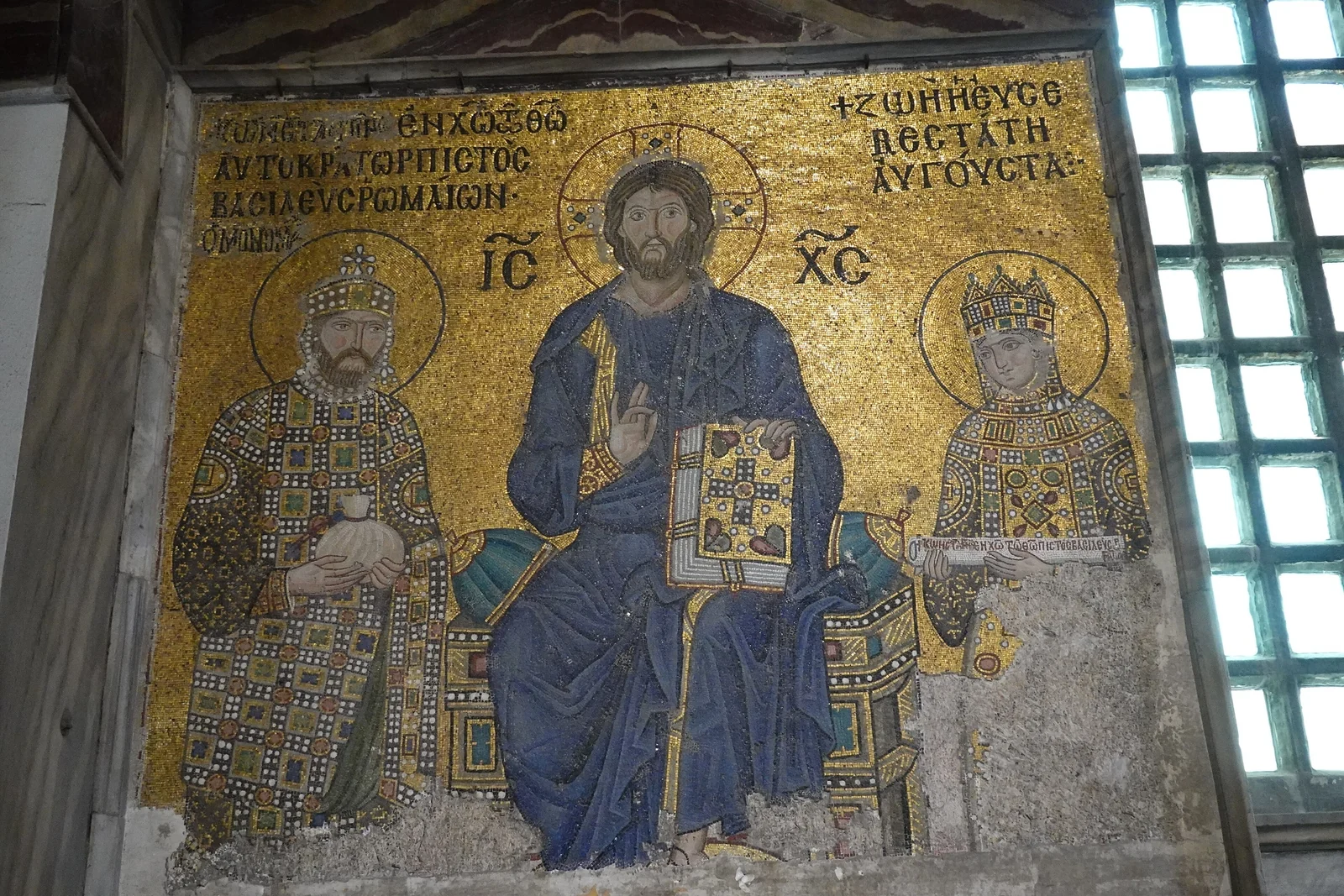
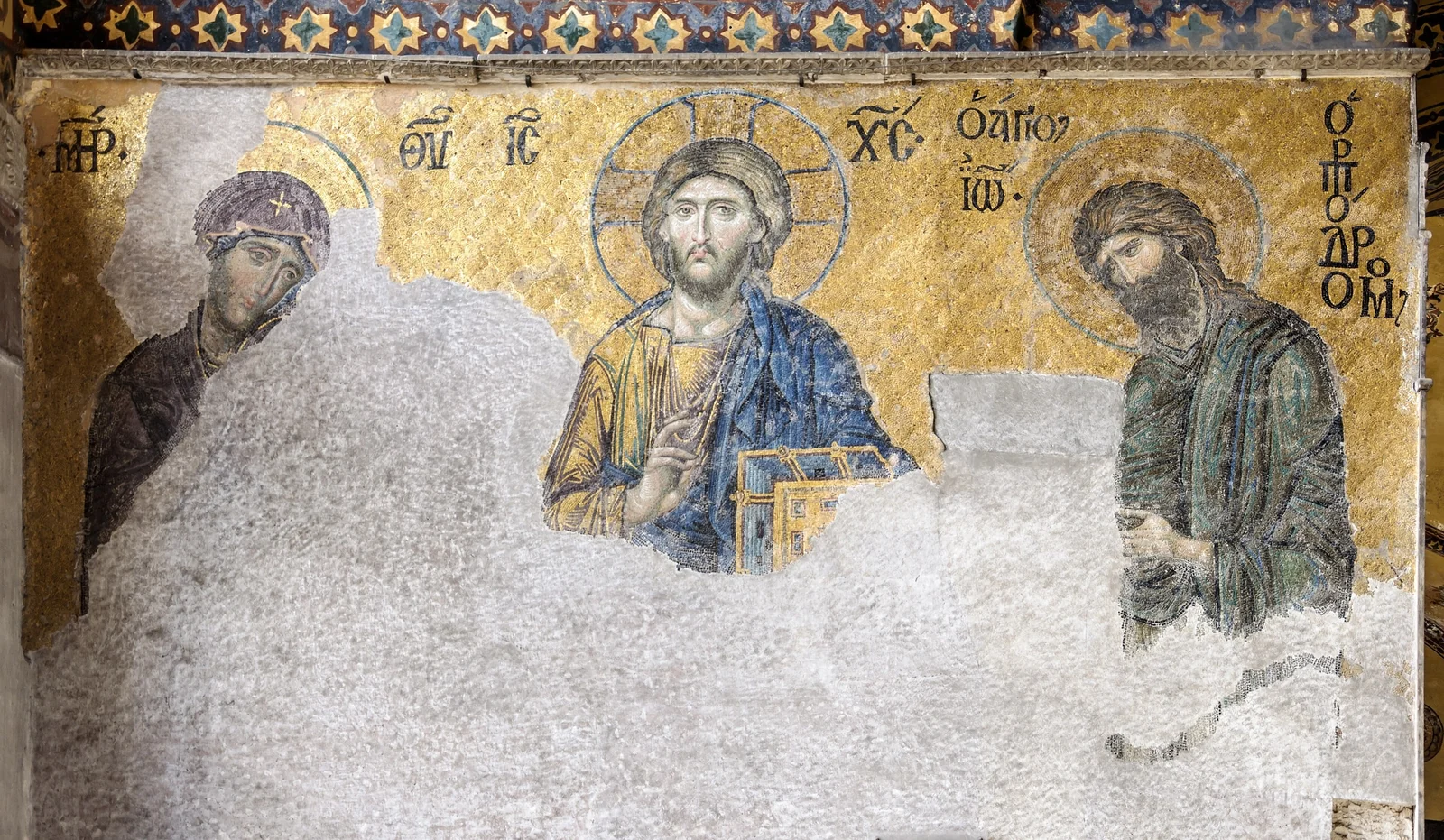
The south gallery holds the finest mosaics. The 13th-century Deesis shows Christ between the Virgin Mary and John the Baptist and is admired for its soft, lifelike faces. Nearby are the Empress Zoe mosaic of the 11th century and the Komnenos mosaic of the 12th century, both showing imperial couples with Christ or the Virgin. On the way out, look up at the mosaic above the southwestern vestibule door, where Emperors Constantine and Justinian present the city and the church to the Virgin and Child.
Other details worth finding
- The Marble Door in the south gallery, a Byzantine stone doorway carved to look like wood, sometimes called the gate of heaven and hell.
- Graffiti on the gallery balustrade, including runes carved by a Viking-era visitor, a reminder of the Varangian Guard who served the emperors.
- The Weeping Column in the northwest of the ground floor, a bronze-clad pillar with a hole where people traditionally place a thumb and make a wish. Access depends on the current route.
During prayers, some Christian images visible from the prayer hall are covered by curtains or lighting effects; the mosaics in the upper galleries remain on the visitor route.
Tips for Visiting Hagia Sophia
- Go early: lines are shortest at opening time. Avoid Friday late mornings and midday.
- Allow 60 to 90 minutes for the galleries and exit route, more if you want to look closely at the mosaics.
- Use the audio or AR guide: the official listing mentions an AR experience in many languages via QR code, and headphones for rent.
- Combine nearby sights: the Blue Mosque, Basilica Cistern and Topkapı Palace are all within a short walk, and the Hagia Sophia History and Experience Museum across the square explains the building with exhibits and projections.
If Byzantine architecture fascinates you, Greece has many more churches and monasteries from the same world, from Thessaloniki to Mystras; our Greece travel guide is a good starting point. For more ideas in the region, see our Türkiye travel guides.
Hagia Sophia FAQ
Is Hagia Sophia a mosque or a museum?
It is a mosque. Hagia Sophia was a museum from 1935 until 2020, when a Turkish court ruling allowed it to be reconverted. It is officially the Hagia Sophia Grand Mosque, but tourists can still visit the upper galleries on a separate paid route.
How much does it cost to visit Hagia Sophia?
Foreign visitors pay 25 euros, charged in Turkish lira, for the tourist route through the upper galleries. Children under 8 enter free with a passport or ID. The Museum Pass Istanbul is not valid. Prices can change, so check the official page before you go.
Can non-Muslims visit Hagia Sophia?
Yes. Visitors of any faith can enter through the tourist entrance and follow the gallery route, as long as they dress modestly and respect worshippers. The ground-floor prayer hall is reserved for people coming to pray.
Is Hagia Sophia closed on Fridays?
It is not closed all day, but tourist access stops around the Friday midday congregational prayer, roughly from noon until about 14:00. Access can also pause briefly during the other daily prayers, so Friday mornings and middays are best avoided.
What is the dress code for Hagia Sophia?
Women need to cover their hair, shoulders and legs, and men should cover their knees and shoulders. Headscarves and body covers are sold at the ticket booth for a small charge, but it is easier to bring a scarf and wear long clothing.
Can you still see the mosaics in Hagia Sophia?
Yes. The most important Byzantine mosaics, including the Deesis, the Empress Zoe and the Komnenos panels, are in the upper galleries, which are part of the paid visitor route. Restoration scaffolding may partly block some views during the current dome works.
How long do you need at Hagia Sophia?
Most visitors spend 60 to 90 minutes on the gallery route. Add time for queues at busy periods and for the Hagia Sophia History and Experience Museum across the square if you want more background on the building.