


Uzbekistan holds the greatest run of Silk Road cities anywhere: Samarkand, Bukhara and Khiva, three oasis towns of turquoise domes and tiled madrasas strung across the desert between Tashkent and the Amu Darya. A fast train links the first three, the food is generous, and the country is far easier to travel than its reputation suggests.
This Uzbekistan Silk Road itinerary covers 10 to 12 days, enough to see the big monuments without sprinting. It runs west from Tashkent to Samarkand, Bukhara and Khiva, with an optional detour to Nukus and the Aral Sea, and ends with the practical side: trains, visas, cash, registration, food, etiquette and the best season to go.
If the route sparks a wider Silk Road obsession, the western terminus waits in Istanbul, where Hagia Sophia shows the Byzantine side of the same trade story. For more on the country, browse our Uzbekistan travel guides.
Tashkent: Soviet Metro, Bazaars and an Ancient Quran
Most international flights land in Tashkent, and many travelers rush straight through. Give it a day and a half. Largely rebuilt after the 1966 earthquake, it is a city of broad avenues rather than old lanes, but three places make it worthwhile.
The Tashkent Metro
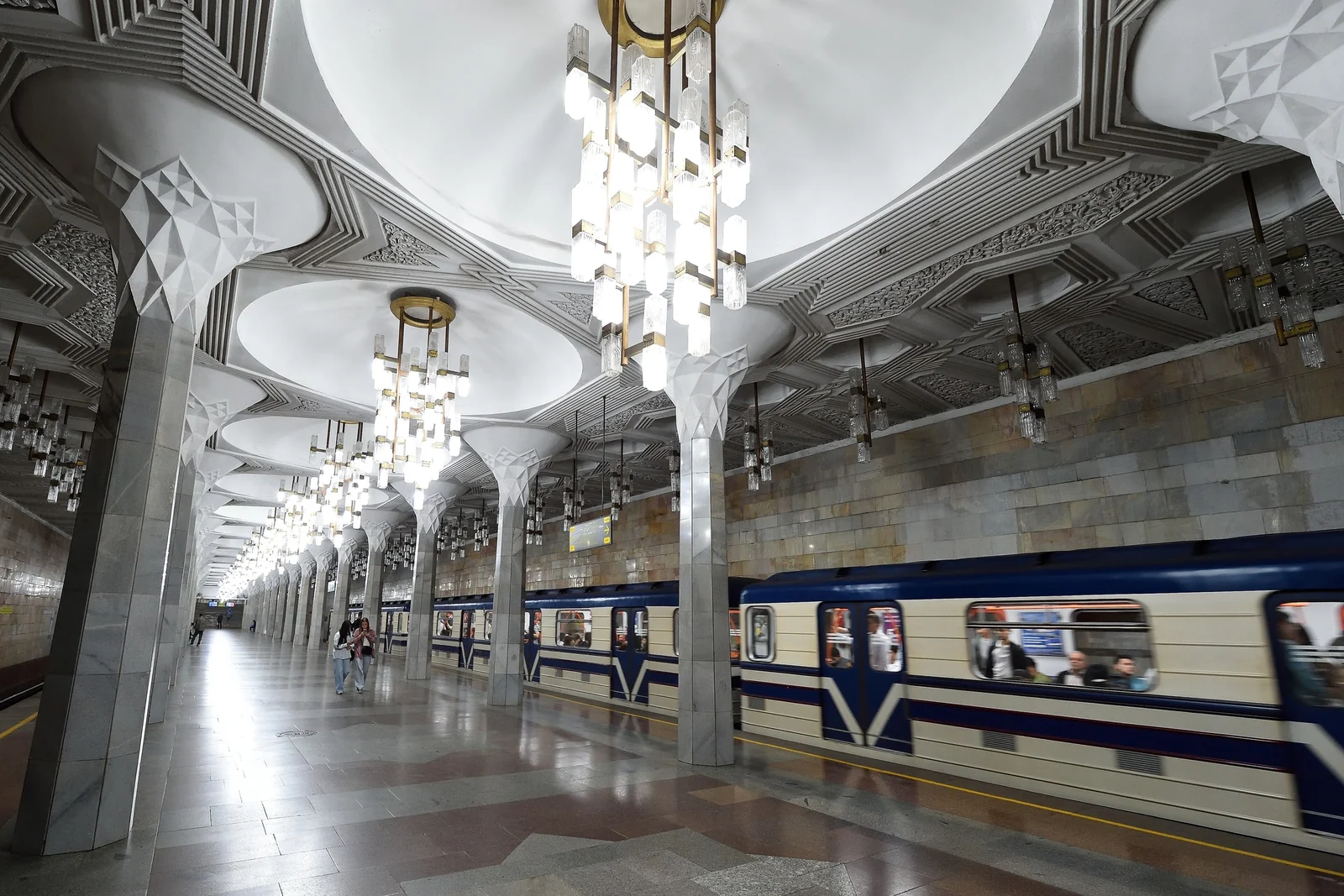
Opened in 1977 as the first metro in Central Asia, Tashkent's underground doubles as a museum of late Soviet design. Each station has its own theme: chandeliers and marble at Mustaqillik Maydoni, deep blue ceramics and portraits of space pioneers at Kosmonavtlar, carved alabaster at Alisher Navoi. Photography was banned for decades; it is allowed now, and a single token or card fare buys you an afternoon of station hopping.
Chorsu Bazaar and Khast Imam
Chorsu Bazaar, under its huge blue-green dome, is where Tashkent shops for spices, dried apricots, horse-meat sausage and fresh non. Come in the morning, wander the bread and dairy rows outside, and eat whatever someone offers you a taste of.
A short walk north, the Khast Imam (Hazrati Imam) complex groups a Friday mosque, madrasas and a small library museum. Its treasure is the Uthman Quran, an early manuscript traditionally linked to the third caliph and widely dated to the seventh or eighth century. Dress modestly; this is an active religious site.
Samarkand: Registan, Gur-e-Amir and Shah-i-Zinda
Samarkand is the one everybody comes for, and it earns the hype. Timur made it his capital in the late 14th century and poured the wealth of his conquests into buildings meant to overwhelm. UNESCO inscribed the city as Samarkand, Crossroad of Cultures in 2001. Plan three nights; two feels rushed.
The Registan
Three madrasas face one another across a sunken square: Ulugh Beg's on the left, built in the 1410s and 1420s, the Sher-Dor opposite with its tiger-like beasts chasing deer, and the Tilya-Kori in the middle, whose mosque interior glitters with gold leaf. Go twice. Early morning gives you soft light and few people; after dark the facades are floodlit and the square fills with local families.
Gur-e-Amir and Bibi-Khanym
Gur-e-Amir, the ribbed-dome mausoleum where Timur lies beside his sons and grandson Ulugh Beg, is smaller than you expect and more beautiful inside than out, all blue and gilded relief. The Bibi-Khanym Mosque, raised in the first years of the 15th century, was among the largest mosques of its age and partly collapsed in later centuries; what stands now is heavily restored, but the scale still lands.
Shah-i-Zinda Necropolis
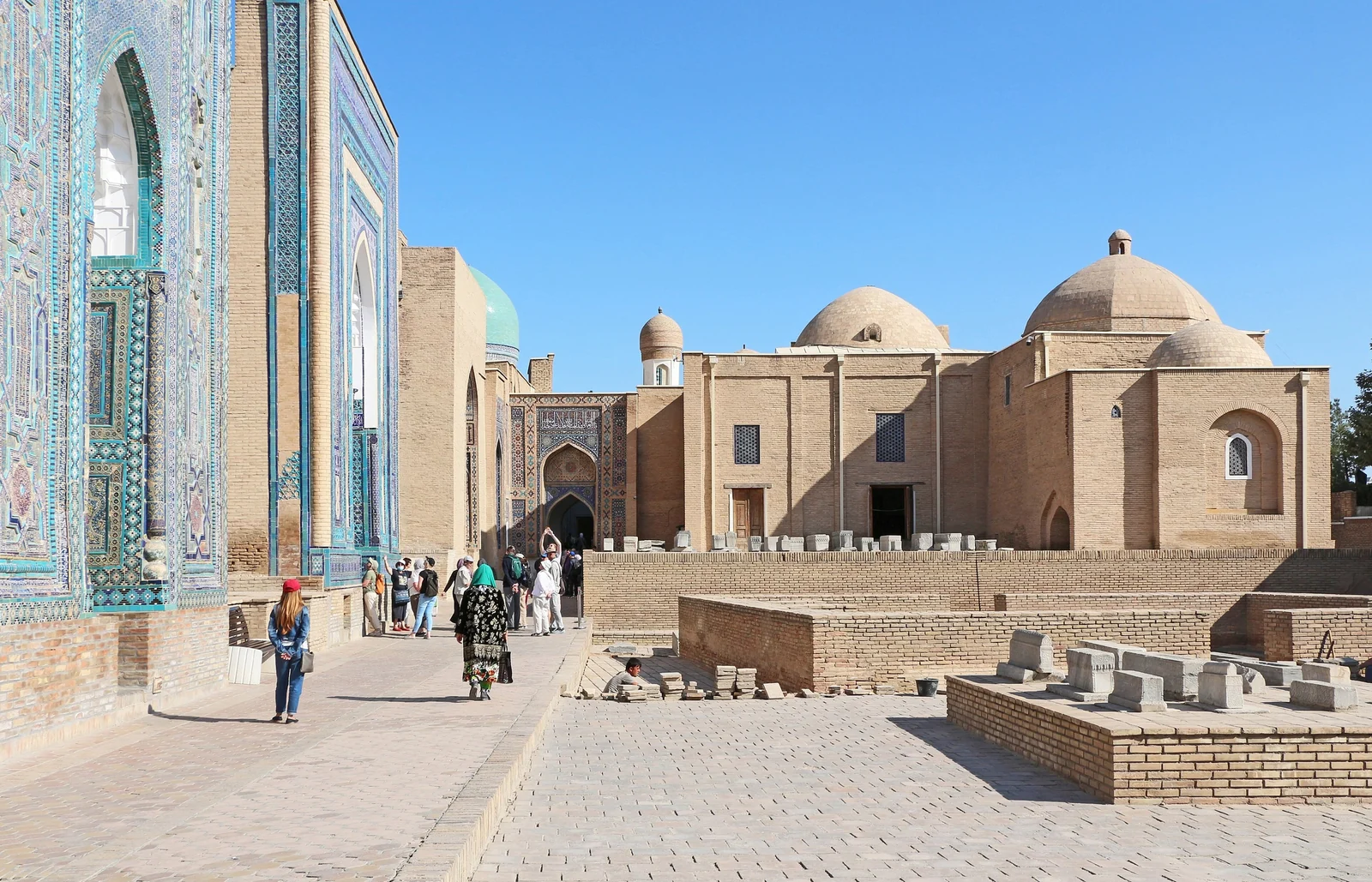
If you only have energy for one Samarkand site in the afternoon heat, make it this one. Shah-i-Zinda is a narrow lane of mausoleums climbing a hillside, built around the shrine traditionally linked to Kusam ibn Abbas, a cousin of the Prophet. Most tombs date from the 14th and 15th centuries, and the tilework, carved, glazed and mosaic, is the finest in the country.
Ulugh Beg Observatory
Timur's grandson preferred stars to sieges. His observatory, built in the 1420s on a hill northeast of town, was destroyed after his death and rediscovered by an archaeologist in 1908. What survives is the curved underground trench of a giant meridian instrument, plus a small museum. Allow under an hour.
Bukhara: Po-i-Kalyan, Lyab-i Hauz and the Ark
Samarkand dazzles; Bukhara is where you slow down. Its historic center, a UNESCO site since 1993, is compact, mostly pedestrian and built in sand-colored brick, with more than a thousand years of mosques, madrasas and caravanserais inside a walk of about 20 minutes. Three nights is ideal.
Po-i-Kalyan Ensemble
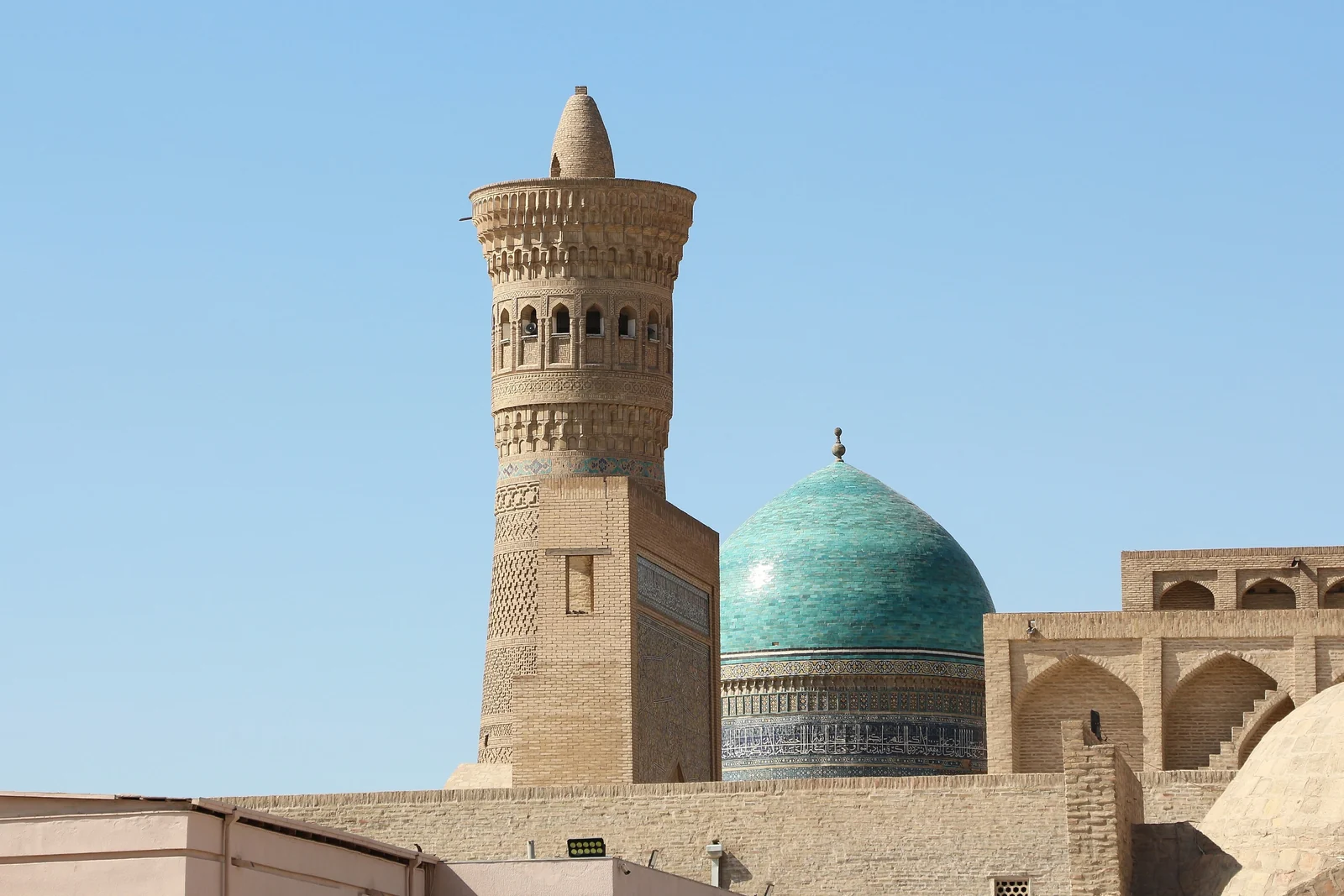
The Kalyan Minaret, finished in 1127 and about 46 meters tall, is so solid that Genghis Khan's army reportedly spared it while flattening much of the city. It stands between the vast courtyard of the Kalyan Mosque and the twin blue domes of the Mir-i-Arab Madrasa, still a working religious school.
Lyab-i Hauz and the Trading Domes
Lyab-i Hauz, a 17th-century pool shaded by old mulberry trees and framed by two madrasas and a khanaqah, is the town's social center: tea, plov, people watching. From there, a lane runs past the domed bazaars of the 16th century, built at crossroads for money changers, cap makers and jewelers. They still sell carpets, suzani embroidery, knives and ceramics.
The Ark and Beyond
The Ark, a massive earthen fortress, was the seat of Bukhara's emirs until 1920. Nearby, the 10th-century Samanid Mausoleum, a cube of patterned brick, is one of the oldest surviving monuments of Islamic Central Asia, and the four little towers of Chor Minor reward a wander through the residential lanes.
Khiva: The Walled City of Itchan Kala
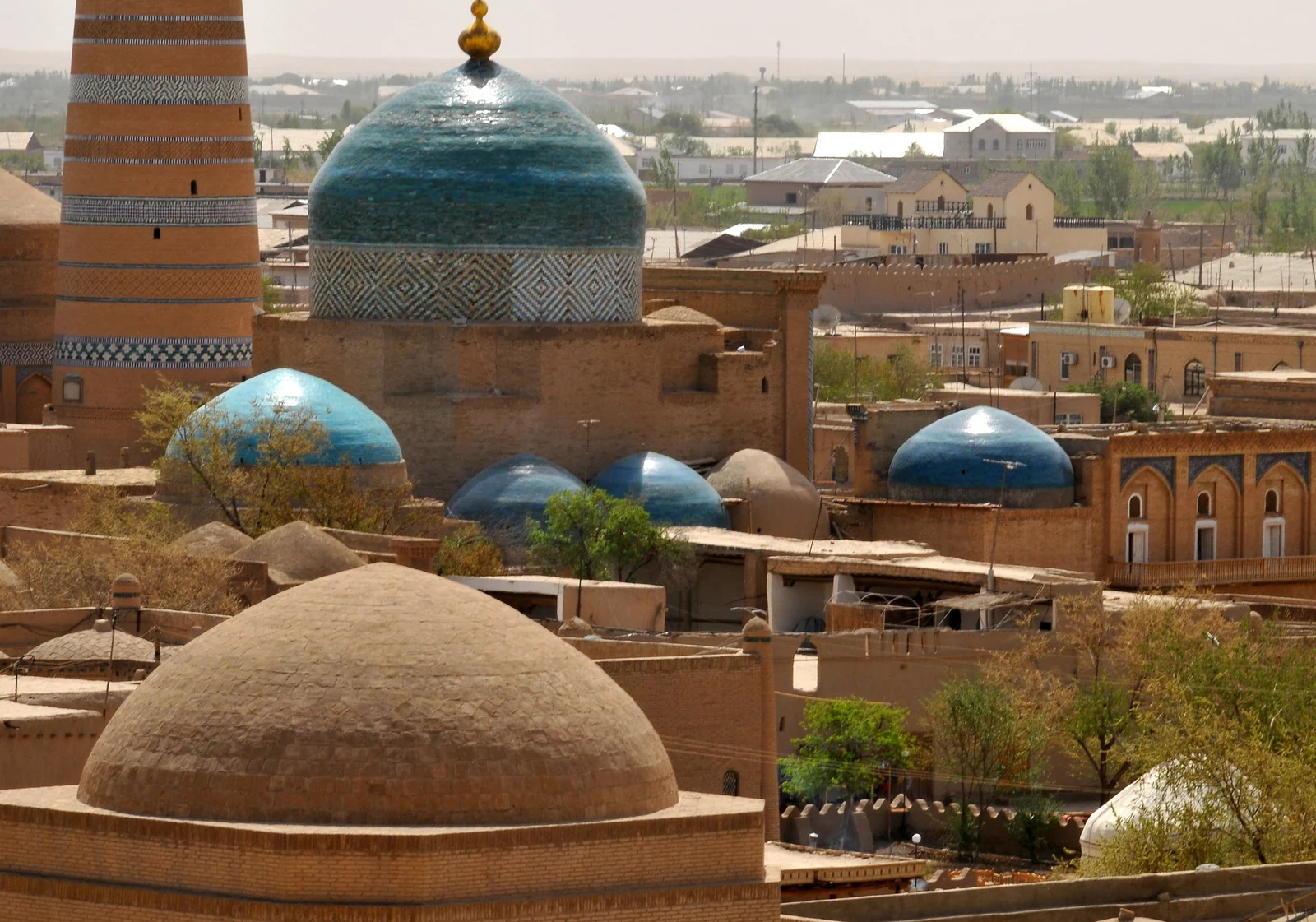
Khiva feels like a model of a Silk Road city that someone forgot to put away. Its inner town, Itchan Kala, sits entirely within mud-brick walls and became Uzbekistan's first UNESCO World Heritage Site in 1990. Most of what you see dates from the 18th and 19th centuries and was heavily restored in the Soviet era, so it can feel polished. Walk the walls at sunset anyway; it works.
- Kalta Minor: a fat, stubby minaret wrapped in turquoise tiles, left unfinished in the 1850s.
- Islam Khodja Minaret: the tallest in Khiva, completed in 1910; climb it for the best view over the domes.
- Juma Mosque: a dim hall of more than 200 carved wooden columns, some far older than the building.
- Kunya Ark and Tash Hauli: the khans' fortress and palace, with tiled courtyards and a watchtower over the west gate.
- Pakhlavan Mahmud Mausoleum: the shrine of Khiva's poet, wrestler and patron saint.
Two nights is enough. Buy the combined ticket at the west gate, which covers most museums inside the walls; a few sites, including the minaret climbs, are charged separately.
Optional Detour: Nukus and the Aral Sea
Nukus, the capital of the autonomous Karakalpakstan republic, is a plain Soviet town with one extraordinary museum. The Savitsky Museum holds the collection Igor Savitsky assembled from the 1960s onward, including thousands of works by Russian and Central Asian avant-garde artists whose styles were out of favor under Stalin. Far from Moscow's censors, they survived here. Allow at least half a day.
From Nukus, tours continue to Moynaq, a former fishing port now stranded far from the water, where rusting trawlers lie in the sand. The shrinking of the Aral Sea, driven by Soviet irrigation of cotton fields, is one of the starkest environmental disasters you can see from the ground. Trips to the remaining shoreline need a 4x4 and a local operator, and add two or three days.
Getting Around: The Afrosiyob Train and Other Transport
The backbone of any trip is the Afrosiyob, a Spanish-built Talgo high-speed train that links Tashkent with Samarkand in a little over two hours and reaches Bukhara in just under four. Seats are assigned, the carriages are clean and air-conditioned, and the popular departures sell out. Buy tickets as early as you can on the Uzbekistan Railways ticket site, and carry your passport, which is checked on boarding. It is one of the great rail rides of Asia, in the spirit of our favorite travel routes.
- Slower trains: the Sharq and regular services cover the same line more slowly and more cheaply; overnight sleeper trains reach Urgench, Khiva and Nukus.
- Bukhara to Khiva: about 450 km across the Kyzylkum Desert by private car or shared taxi, roughly six to seven hours; trains also run on this section.
- Flights: domestic flights connect Tashkent with Urgench (about 30 km from Khiva) and Nukus, handy for skipping the long return leg.
- In cities: ride-hailing apps such as Yandex Go work in Tashkent and Samarkand, and taxis are inexpensive. The old towns of Bukhara and Khiva are best on foot.
A 10 to 12 Day Uzbekistan Route
| Days | Base | Highlights | Getting there |
|---|---|---|---|
| 1–2 | Tashkent | Metro stations, Chorsu Bazaar, Khast Imam | International flight |
| 3–5 | Samarkand | Registan, Gur-e-Amir, Shah-i-Zinda, Bibi-Khanym, Ulugh Beg Observatory | Afrosiyob, about 2 hours |
| 6–8 | Bukhara | Po-i-Kalyan, Lyab-i Hauz, trading domes, the Ark, Samanid Mausoleum | Afrosiyob or regular train from Samarkand |
| 9–10 | Khiva | Itchan Kala, Kalta Minor, Juma Mosque, sunset on the walls | Car or train across the desert |
| 11–12 (optional) | Nukus and Moynaq | Savitsky Museum, ship graveyard, Aral Sea trip | Road or train from Khiva |
| Last day | Urgench or Nukus | Fly back to Tashkent for your onward flight | Domestic flight |
Short on time? Cut Nukus and one Bukhara night for a tight but rewarding nine days.
Visas, Money and Registration
Visas
Uzbekistan has opened up a great deal in recent years. Many nationalities can now visit visa-free for a set number of days, and most others can apply online for an e-visa through the official e-visa portal. Rules change and vary by passport, so check the portal and your own government's travel advice before you book, and make sure your passport has plenty of validity left.
Cash and Cards
The currency is the som. ATMs are common in the cities and many hotels, restaurants and the railway accept international cards, but bazaars, small guesthouses, taxis and village cafés run on cash. Carry a mix: withdraw som from ATMs at banks, keep some clean US dollars or euros as a backup, and change money only at banks or official exchange counters.
Registration
Foreign visitors must be registered with the authorities, generally within three days of arrival. Hotels and licensed guesthouses do this automatically when you check in and give you a slip or QR-code receipt. Keep every one of them until you leave. If you stay with friends or in an unlicensed apartment, ask your host how registration will be handled before you arrive.
Food and Etiquette: Plov, Samsa and Non
Uzbek food is hearty, meat-heavy and built around bread. Plov, rice cooked in huge cauldrons with carrots, lamb or beef, cumin and sometimes chickpeas and quail eggs, is the national dish and a matter of regional pride; it is traditionally a lunch food, so popular plov houses often sell out by early afternoon. Samsa, flaky pastries filled with meat and onion and baked against the wall of a tandoor, are the classic snack. Look also for lagman noodles, shashlik and green tea poured into small bowls.
Non, the round, stamped flatbread, is close to sacred. Never put it face down, never throw it away, and let your host break it by hand and share it around the table.
- Dress: Uzbekistan is relaxed by regional standards, but cover shoulders and knees at religious sites, and women should carry a scarf for active mosques and shrines.
- Greetings: a hand on the heart with a slight nod is a polite greeting or thank you; men often shake hands, but wait for a woman to offer hers.
- Hospitality: you will be offered tea, fruit and bread. Accept a little even if you are full.
Best Time to Visit Uzbekistan
Spring and autumn win easily. April to early June brings mild days, green oases and blossom; September to October brings harvest season, piles of melons and grapes in the bazaars and clear skies. These are also the busiest months, so book trains and the better guesthouses well ahead.
- Summer (July and August): fierce, dry heat, often near or above 40 °C in Bukhara and Khiva. Sightsee early and late, rest at midday.
- Winter (December to February): cold, sometimes snowy, with short days, but empty monuments and lower prices.
- Navruz in late March: the Persian New Year brings festivals, music and sumalak, a sweet wheat dish cooked overnight.
For more ideas around the region, browse our Asia travel guides.
Uzbekistan Silk Road FAQ
How many days do you need in Uzbekistan?
Ten days covers Tashkent, Samarkand, Bukhara and Khiva at a comfortable pace, with three nights each in Samarkand and Bukhara. Twelve days lets you add Nukus and the Aral Sea or a day trip to Shahrisabz. A week is possible if you skip Khiva or fly one leg.
Is it better to visit Samarkand or Bukhara?
See both if you can. Samarkand has the grander, more monumental buildings, including the Registan and Shah-i-Zinda. Bukhara has the more atmospheric, walkable old town, with centuries of architecture packed into a small area and a slower evening scene around Lyab-i Hauz.
Does the Afrosiyob train go to Khiva?
The Afrosiyob high-speed service is mainly used between Tashkent, Samarkand and Bukhara. For Khiva, most travelers take slower trains, including overnight services, a car across the desert from Bukhara, or a domestic flight to Urgench. Check current routes on the official Uzbekistan Railways site.
Do I need a visa for Uzbekistan?
It depends on your passport. Many nationalities can enter visa-free for a limited number of days, and many others can apply for an e-visa online. Rules change, so check the official e-visa portal and your government's travel advice before booking flights.
Can I use credit cards in Uzbekistan?
In larger hotels, many restaurants and for train tickets, often yes. Bazaars, taxis, small guesthouses and rural cafés usually want cash in som. ATMs are easy to find in cities, but bring a backup of clean US dollars or euros and change money only at banks or official counters.
What is the best time to visit Uzbekistan?
April to early June and September to October offer warm days, cool evenings and the best light for the monuments. Summer is very hot in Bukhara and Khiva, often near 40 °C, while winter is cold but quiet. Book ahead in spring and autumn.