


Prague is the capital of the Czech Republic and one of the best-preserved medieval and baroque cities in Europe. Its historic center has been on the UNESCO World Heritage list since 1992, and it is easy to see why: a Gothic bridge, a hilltop castle, a 600-year-old clock and a river that ties it all together, all within walking distance of each other.
Three days is the right length for a first visit, with a fourth for a day trip. This Prague travel guide covers the main sights in a sensible order, what to eat and drink, how to get around, where to stay and how to avoid the places that exist mainly to separate visitors from their money. For more of the country, see our Czech Republic travel guides.
Old Town Square and the Astronomical Clock
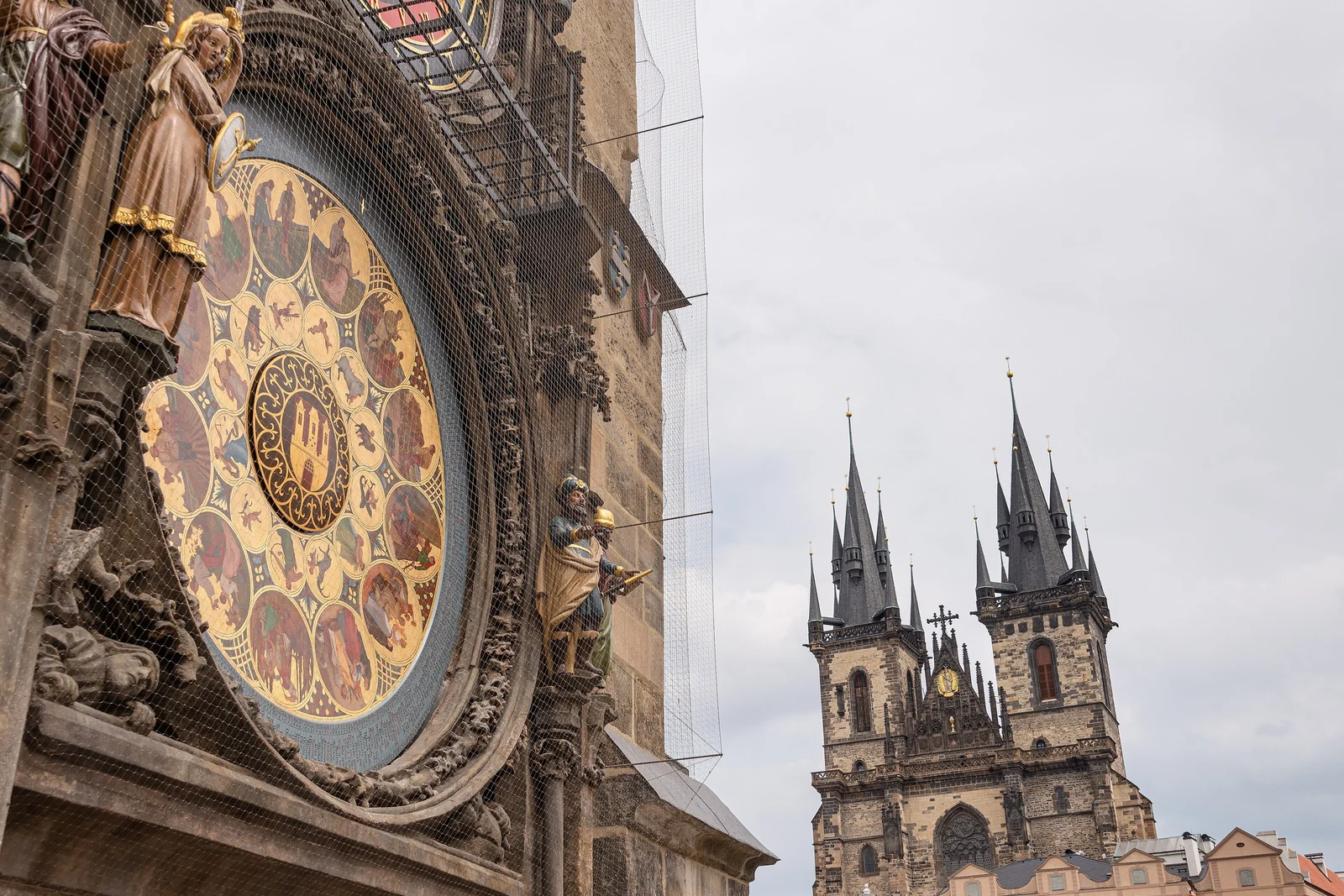
Staré Město, the Old Town, grew up around a market square that is still the city's main stage. Two Gothic spires of the Church of Our Lady before Týn dominate one side, the baroque St. Nicholas Church sits on another, and the Old Town Hall tower closes in the third. The square is lovely at 8 a.m. and a scrum by noon.
The Astronomical Clock
The Prague Astronomical Clock (Orloj) on the Old Town Hall dates to 1410 and is the oldest of its kind still working. Every hour from 9 a.m. to 11 p.m., a procession of apostles appears in the upper windows while a skeleton figure representing Death tolls a bell. It lasts under a minute and is no spectacle.
Look at the dials instead. The big blue-and-gold face tracks the sun, the moon and the zodiac, and the lower calendar plate marks the months. For the best view of the square, climb the Town Hall tower and buy a ticket through the official Prague tourist portal or at the door.
Charles Bridge and Malá Strana
Charles Bridge was begun in 1357 under Emperor Charles IV and linked the Old Town with the castle side of the river for centuries. Today it is a pedestrian bridge lined with baroque statues, street artists and, after about 9 a.m., a slow-moving crowd. Walk it at sunrise or after dark if you want to actually see it.
At the far end you enter Malá Strana, the Lesser Town, a district of baroque palaces, walled gardens and steep cobbled lanes below the castle. Lose the main street almost at once. Kampa Island, reached by a stair from the bridge, is quiet and good for river views, and the Church of St. Nicholas is the finest baroque interior in the city.
Prague Castle and St. Vitus Cathedral
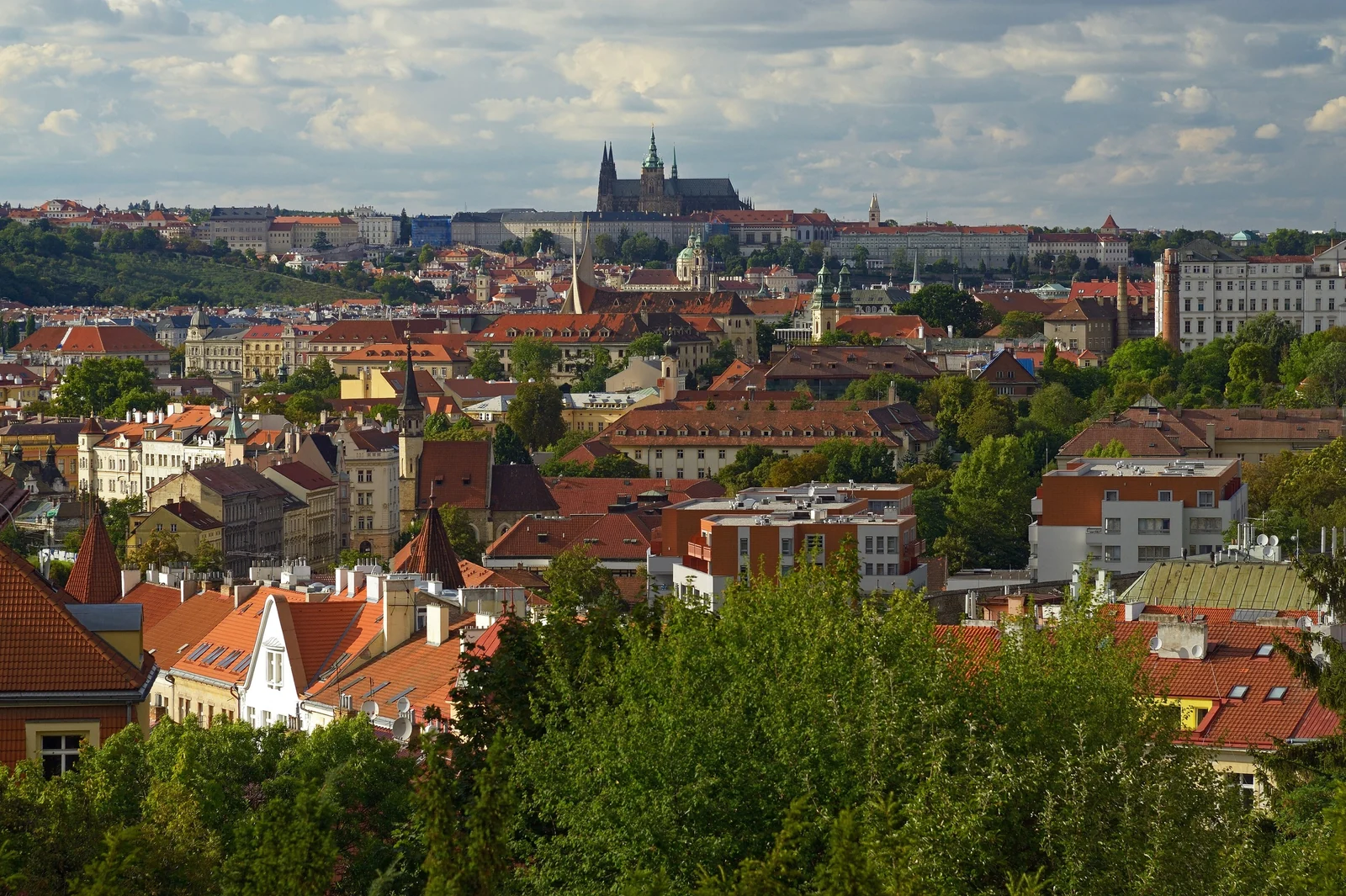
Prague Castle is less a single building than a walled hilltop complex of palaces, churches and courtyards, and it is among the largest castle complexes in the world. Its heart is St. Vitus Cathedral, begun in 1344 and not finished until 1929, which explains its mix of Gothic vaults and neo-Gothic spires. The stained glass, especially the Art Nouveau window by Alphonse Mucha, is the highlight inside.
The castle grounds are free to enter, but you need a ticket for the cathedral interior, the Old Royal Palace and Golden Lane, the row of tiny colored houses along the wall. Ticket circuits and opening hours change by season, so check the official castle website before you go. Arrive when the gates open, since tour groups fill the courtyards from mid-morning.
Walk down rather than up when you leave. The Nový Svět lane, just behind the castle, is a short, almost silent street of small cottages that feels like a different century.
Josefov, Vyšehrad and the Local Neighborhoods
Josefov, the Jewish Quarter
Josefov sits just north of the Old Town Square and holds some of the most important Jewish heritage in Europe. The Old New Synagogue, from the late 13th century, is one of the oldest working synagogues in Europe. Nearby, the Old Jewish Cemetery packs layers of gravestones into a tiny, crowded plot. Entry is by combined ticket through the Jewish Museum in Prague, and the synagogues close on Saturdays and Jewish holidays.
Vyšehrad
Vyšehrad is a second fortress on a rock above the Vltava, south of the center, and a favorite picnic spot for locals. The twin spires of the Church of St. Peter and St. Paul are a landmark, the Vyšehrad Cemetery holds the graves of Antonín Dvořák and Bedřich Smetana, and the ramparts give you the best view of the castle across the river.
Vinohrady and Žižkov
East of the New Town, Vinohrady is a leafy residential district of 19th-century apartment blocks, wine-bar terraces and Riegrovy sady, a hillside park where people drink beer at sunset with the castle in view. Neighboring Žižkov is scruffier and louder, famous for its density of pubs and for the Žižkov TV Tower, a Soviet-era landmark known for the baby sculptures crawling up its shaft. This is where Prague lives, and where you'll eat and drink for far less than around the Old Town.
Czech Food and Beer Culture
Czech cooking is hearty, built on meat, gravy, dumplings and cabbage, and it suits cold weather better than hot. The beer is the reason to linger.
Dishes to Try
- Svíčková: marinated beef sirloin in a creamy root-vegetable sauce, served with sliced bread dumplings, a spoonful of cranberries and a slice of lemon. It is the dish Czechs order to test a restaurant.
- Guláš: a thick beef stew, usually with bread dumplings, closer to the Hungarian original than to a soup.
- Smažený sýr: breaded and fried cheese with tartar sauce. Not subtle, but a classic pub order.
- Vepřo knedlo zelo: roast pork, dumplings and sauerkraut, often described as the national plate.
- Chlebíčky: small open-faced sandwiches sold at delis for a quick, cheap lunch.
The Trdelník Reality Check
The rolled, sugar-dusted pastry cooked over coals and sold on every tourist street is called trdelník, and it is not a traditional Prague dessert. It comes from the same family as the Hungarian-Transylvanian kürtőskalács, and the version associated with Skalica in Slovakia has EU protected status. It only became a Prague street-food fixture with the rise of mass tourism. It can be fine fresh, but it is a snack for visitors, not a local habit, and the ice cream filling is a modern add-on. For a genuinely Czech sweet, look for koláče or trubičky in a bakery.
Pubs and Beer
The Czechs are among the world's heaviest beer drinkers per person, and the golden lager style takes its name from Plzeň, where Pilsner Urquell was first brewed in 1842. In a traditional hospoda you sit, and the staff keep bringing you beer until you put a coaster over the glass. Order a světlé (light) or tmavé (dark), ask for tankové if it is on offer for the freshest, unpasteurized pour, and tip by rounding up. Prices are far lower than in Western Europe in any pub more than five minutes from a main square.
A 3-Day Prague Itinerary
Day 1: Old Town, Josefov and the Bridge
Start early in Old Town Square, before the crowds, and catch the clock at 9 a.m. Spend the late morning in Josefov, then lunch somewhere a few streets off the square. Walk Charles Bridge at sunset, and finish with dinner in Malá Strana.
Day 2: The Castle and Malá Strana
Take a tram up to the castle for the opening. Spend the morning in the cathedral, palace and Golden Lane, walk down through Nový Svět, then spend the afternoon in Malá Strana and on Kampa Island. Round out the day with a beer at a Malá Strana pub, away from the bridge.
Day 3: Vyšehrad, Vinohrady and Žižkov
Start at Vyšehrad, walk or take the metro to Vinohrady for lunch, and spend the afternoon at Riegrovy sady. Eat dinner and drink in Žižkov, where the pubs run late and the prices drop. Planning a wider trip through the region? Our Kraków guide covers a similar blend of old town, castle hill and food.
Day Trips from Prague
| Destination | Getting there | Approx. travel time | Best for |
|---|---|---|---|
| Kutná Hora | Train from Prague main station | About 1 hour | Medieval silver town, Sedlec Ossuary |
| Karlštejn | Regional train, then a short walk uphill | About 40 minutes | A Gothic castle built by Charles IV |
| Terezín | Bus from Florenc station, or a tour | About 1 hour | Fortress town and WWII memorial |
| Český Krumlov | Direct bus, or a tour | About 3 hours | A South Bohemian castle town, best overnight |
Times are approximate; check current timetables.
Kutná Hora
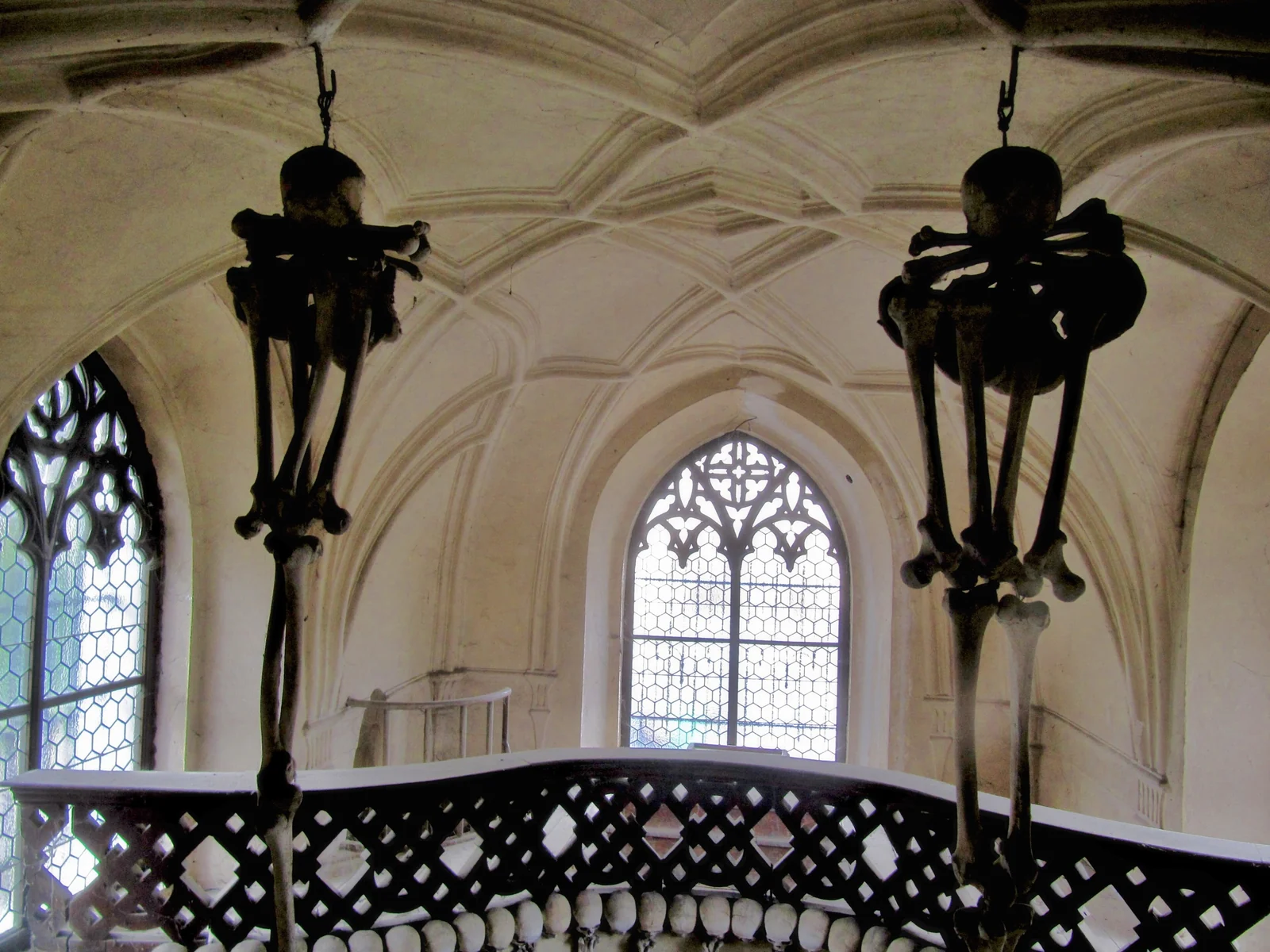
Kutná Hora grew rich on silver mining in the Middle Ages, and the town center, with the Gothic Cathedral of St. Barbara, has been UNESCO-listed since 1995. The famous stop is the Sedlec Ossuary, a small chapel decorated with the bones of tens of thousands of people, including a chandelier said to contain every bone in the human body. It is grim, but also strangely beautiful, and it is easy to combine with the cathedral in a single day.
Karlštejn
Charles IV founded Karlštejn Castle in 1348 to guard the imperial crown jewels and holy relics. The walk up from the village is short but lined with souvenir stalls. Interiors are usually visited on a guided tour, and the more demanding routes need advance booking, so check the castle's official site first.
Terezín
Terezín is a sobering visit. The fortress town was built in the 1780s and named after Empress Maria Theresa. In the Second World War the Nazis used the Small Fortress as a prison and the town as a ghetto and transit camp. The memorial and museums handle it with care, and it deserves a full half-day rather than a rushed stop.
Český Krumlov
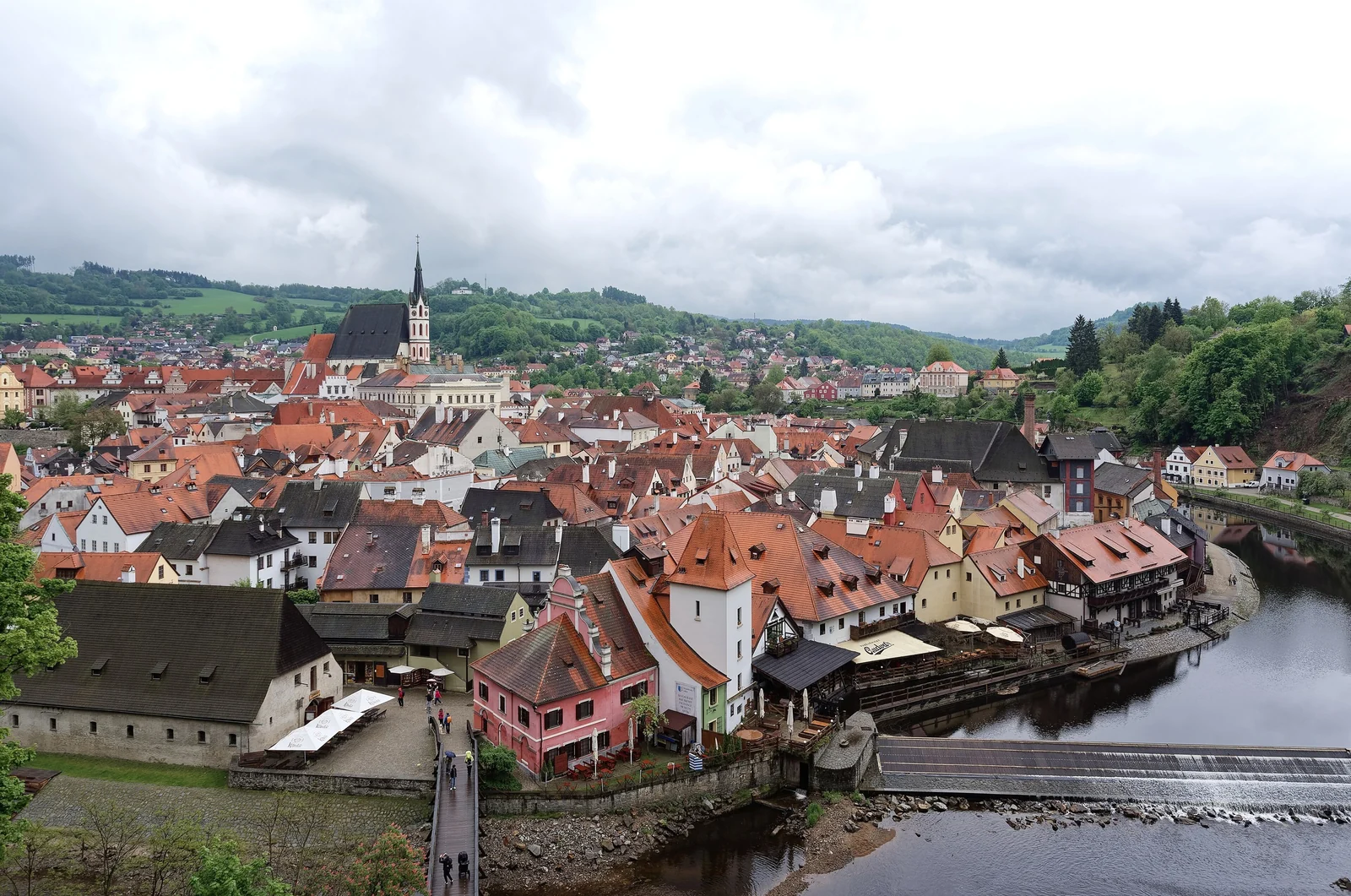
Český Krumlov, in South Bohemia, is a medieval town curled inside a loop of the Vltava and crowned by a huge castle. It has been UNESCO-listed since 1992 and is the most scenic of these four trips. It is also a long day from Prague, so if you can, stay a night after the day-trippers leave.
Best Time to Visit Prague
- April to June and September to October: the best balance of mild weather, long days and manageable crowds.
- July and August: warm, the busiest and often the most expensive. Expect heavy crowds at the main sights.
- Late November to early January: Christmas markets fill the Old Town Square and Wenceslas Square, with cold weather and early dark.
- January to March: cold, gray and quiet, with the lowest prices and the easiest sightseeing.
Getting to and Around Prague
Václav Havel Airport lies northwest of the center, and public buses and an express service connect it to the metro and the main railway station. Trains from Vienna, Berlin, Dresden and other neighbors arrive at the main station, Praha hlavní nádraží, on the edge of the New Town.
The center is best on foot, but the hills around the castle are steep. For anything else, the metro has three lines, trams cover most of the city and one ticket system covers all of them. The Prague Public Transport Company lists current fares and passes. Buy a ticket before boarding and validate it if the type requires it. The Czech Republic uses the koruna (CZK), not the euro, so use bank ATMs rather than currency booths in the center.
Where to Stay in Prague
- Old Town (Staré Město): the most convenient base, walkable to everything, but the loudest and priciest.
- Malá Strana: quieter and atmospheric, with a climb to the castle. Good if you want evenings away from the crowds.
- New Town (Nové Město): practical and well connected, close to the main station and Wenceslas Square.
- Vinohrady: residential and relaxed, with good restaurants and a short metro ride to the center. My pick for a longer stay.
- Žižkov: the cheapest of the central options and the best for nightlife, though rougher in places.
Avoiding Tourist Traps in Prague
- Restaurants on Old Town Square: you pay for the view, and quality is often average. Walk two or three streets away.
- Currency exchange booths: many advertise a no-commission rate with poor real rates. Use an ATM and pay in koruna when asked.
- Trdelník stands: see above. One is plenty, if any.
- Unlicensed taxis: hail a taxi through an app or from a marked rank, and agree the fare first.
- Menus without prices: if a menu does not list prices, leave.
Heading on to another capital? Compare notes with our Copenhagen guide, or browse all European destinations.
Prague Travel FAQ
How many days do you need in Prague?
Three days cover the Old Town, Charles Bridge, the castle, Josefov and a neighborhood or two without rushing. Add a fourth day for Kutná Hora, Karlštejn or Terezín, and a night or two more for Český Krumlov.
Is the Astronomical Clock worth seeing?
Yes, briefly. The hourly show from 9 a.m. to 11 p.m. is short and often crowded, but the clock itself is the oldest still working of its kind. Watch once, then study the dials and climb the tower for the view.
Is trdelník a traditional Czech dessert?
No. It is related to the Hungarian-Transylvanian chimney cake, and the Skalica version from Slovakia has EU protected status. It became a Prague street-food staple only with mass tourism. Try koláče or trubičky at a bakery for something more local.
Does Prague use the euro?
No, the Czech Republic uses the koruna (CZK). Many tourist businesses accept cards, but small pubs sometimes prefer cash. Withdraw from a bank ATM and avoid street exchange booths, which offer poor rates.
What should you eat in Prague?
Start with svíčková, a beef sirloin in creamy sauce with dumplings, then try guláš, fried cheese and roast pork with sauerkraut. Pair them with a local lager in a traditional pub rather than a restaurant on the main square.
What is the best day trip from Prague?
Kutná Hora is the easiest, about an hour by train, with a UNESCO-listed center and the Sedlec Ossuary. Karlštejn suits castle lovers, Terezín is a serious historical visit, and Český Krumlov is the most scenic but best as an overnight.
Is Prague safe for tourists?
Prague is generally safe, and violent crime against visitors is uncommon. The main risks are pickpockets on trams, the bridge and in crowded squares, and overpriced taxis or exchange booths. Keep valuables close and use a taxi app.